
A fixed daily plan can become inaccurate before the day is half over. The calendar stays the same while available time, attention, pace, and interruptions change.
The Capacity Day Planner keeps the structure that still matters and lets optional work move between three lanes. It is a one-page printable, available in US Letter and A4.
See the whole planning surface
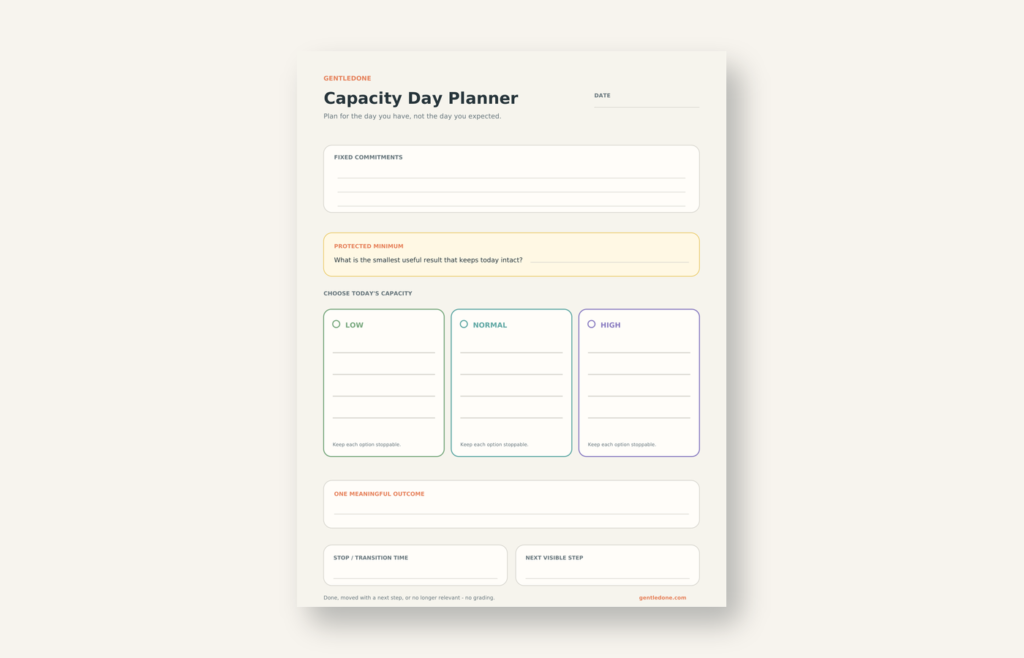
The page is deliberately small. It does not hold your entire backlog, long-term projects, habits, meal plan, and notes. It answers one question: what can this day realistically hold now?
Write fixed commitments before tasks
Start with appointments, pickups, deadlines that truly happen today, and the time you need to stop. Include travel or preparation when it changes the usable block around an event.
Do not fill every gap. A gap may be recovery, travel, food, or the transition that keeps the next commitment from becoming rushed.
Protect one minimum
The protected minimum is the smallest useful result that keeps the day intact. It might be attending one appointment, submitting one required form, preparing food, or leaving tomorrow a safe next step.
This is not the smallest possible action in your life. It is the smallest result that protects today from its most important consequence.
Choose the lane that fits now
- Low: concrete, familiar, safely stoppable work with little setup or decision-making.
- Normal: the regular version of the day, including familiar production and ordinary coordination.
- High: demanding analysis, writing, unfamiliar problems, or work that benefits from a longer clear block.
Write only a few options in each lane. The lanes are a menu, not three lists you must finish. If capacity changes after lunch, choose from a different lane without rebuilding the entire plan.
For a detailed example, read How to Plan a Day When Your Energy Is Unpredictable.
Choose one meaningful outcome
A meaningful outcome gives the day direction without making every task compete for first place. Write an observable result such as “send the revised proposal,” “clear one food-prep surface,” or “confirm the appointment and transport.”
If the first step still creates resistance, use the Contact-Step Ladder to move from Do to Prepare, Place, or Contact.
Set the exit before the day expands
Add a stop or transition time. Then write the next visible step for anything that must continue later. A clean handoff prevents unfinished work from becoming a fresh discovery problem tomorrow.
At the end of the day, mark the main outcome as done, moved with a next step, or no longer relevant. Do not grade the entire day.
See how one changing day fits the page
Suppose the day contains a 2 p.m. appointment, a required form, a report you hoped to finish, groceries, and ordinary messages. The morning begins with less usable capacity than expected.
Fixed commitments hold the appointment and travel time. The protected minimum becomes submitting the required form. Low-capacity options might include opening the report, labeling the current data file, confirming the grocery list, and answering one message with today’s consequence. Normal options might include drafting the report summary and collecting groceries. High-capacity work can hold the full analysis block without pretending it must happen today.
The meaningful outcome is the submitted form. If the day improves, you can choose from another lane. If it does not, the critical consequence is protected and the report has a visible entry point.
When this page is not the right tool
Do not use the planner to pack more work into a day that is already full of commitments. It also does not replace a project list, shared family calendar, or professional support for a health or safety concern.
If every task repeatedly lands in the High lane, the issue may be unclear project steps rather than daily capacity. Break one project into visible actions before filling another planner page.
Download the planner
Choose the page size that matches your printer. Print at 100% or Actual Size. You can also keep the PDF on a tablet and write over it in a PDF annotation app.
Keep one clean copy rather than downloading it again each day. If you want other problem-based printables and guides, return to the GentleDone Tools Library.