

A blocked task can be impossible to act on and still occupy attention all day. You are waiting for a signature, a delivery, an answer, an approval, or a date. Because the task matters, you keep it on the active list. Because no action is available, you keep rereading it.
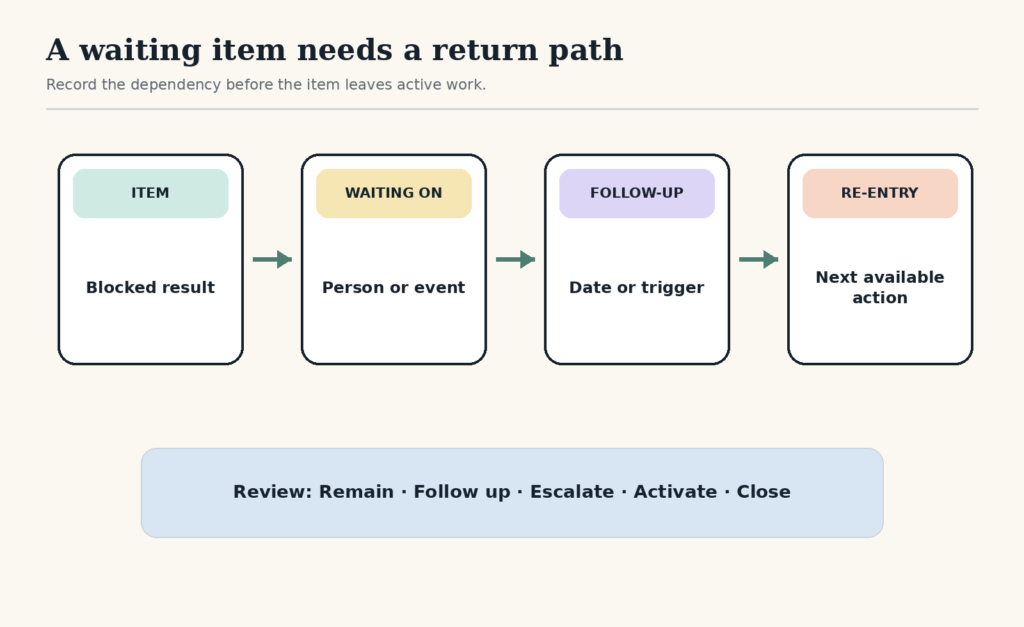
A waiting list separates responsibility from immediate action. It records the dependency, the next review point, and the action that becomes possible when the wait ends.
A waiting item needs four fields
| Field | Question | Example |
|---|---|---|
| Item | What result is blocked? | Submit insurance claim |
| Waiting on | Who or what must happen? | Clinic sends itemized receipt |
| Follow-up | When will I check or contact? | Tuesday, 18 August |
| Re-entry | What action opens when it arrives? | Attach receipt and submit portal form |
“Insurance claim — waiting” is too thin. It keeps the same uncertainty. The four fields let your future self see whether action is available without reconstructing the story.
Move only genuinely blocked work
A task belongs on the waiting list when another person, event, date, delivery, or system must change before your next action exists. It does not belong there when the next action is uncomfortable but available.
- “Waiting for Alex to approve the copy” is blocked.
- “Need to ask Alex for approval” is active; the next action is send the request.
- “Waiting until the invoice is due on Friday” is date-triggered.
- “Thinking about whether to invoice” is a decision, not a wait.
If you cannot name what must change, clarify one visible movement before placing the item anywhere.
Set the follow-up from risk
Do not choose a follow-up date only because weekly review happens on Friday. Work backward from the consequence:
- Name the hard or useful deadline.
- Allow time for one follow-up and one correction.
- Set the first review before that buffer disappears.
A low-consequence book order can wait for the expected delivery date. A permit, payment, travel document, or care-related record may need a wider margin. Put high-consequence items on the appropriate professional or official system as well; a personal waiting list is not a substitute for required tracking.
Review by trigger, not by anxiety
Keep the list closed between review points unless new information arrives. Use one of three triggers:
- a follow-up date appears on today’s list;
- the awaited email, file, delivery, or decision arrives;
- a regular review catches items whose date or risk changed.
This creates a trustworthy return path. It also makes communication checkpoints more useful: when you open email, you can check for named waiting items instead of scanning everything for a feeling of unfinished business.
Leave a ready-to-resume action
Research on interrupted tasks found that making a brief ready-to-resume plan can reduce attention residue during the interrupting work. A waiting item is a longer interruption, and the study does not directly test every real-world delay. Still, the same practical principle applies: preserve the state and next action before attention moves elsewhere. See the original research.
Write the re-entry action as if the awaited item has just arrived: “Open the portal, attach the signed form, and submit.” Avoid “continue claim” or “deal with approval.”
Example: five blocked items become two actions
Leo’s active list contains “printer repair,” “venue contract,” “tax form,” “website photo,” and “refund.” None can move today. He creates five waiting records with owners and follow-up dates.
During the review, he discovers that the refund has no request on record; sending that request is active work. The website photo is not blocked either—he can choose a temporary image. The other three remain on the waiting list. Five vague obligations have become two current actions and three dated waits.
Close or escalate deliberately
At each review, choose one state:
- Remain waiting: the dependency is valid and the follow-up date still protects the consequence.
- Follow up: send the smallest message that can move the item.
- Escalate: use the required formal route when the consequence or deadline warrants it.
- Activate: the dependency arrived; move the next action to current work.
- Close: the item is completed, cancelled, or no longer relevant.
Pair the waiting list with Today, Soon, and Not Now when available tasks also need boundaries. A waiting list works when blocked items become findable without staying mentally foregrounded.
Free GentleDone resource
Overwhelmed? Start with 10 minutes.
The GentleDone 10-Minute Reset gives you one deliberately small place to begin.