

“Website,” “move,” “taxes,” and “course” can sit on a task list for weeks because they are not actions. They are containers. Each contains decisions, missing information, deliverables, and several different kinds of work.
To create a visible next action, identify what must become true next, choose the type of movement, and write the first change another person could observe.
Find the next state, not the whole plan
Ask: What would be different after one useful session?
For a website, the next state might be “the homepage has an approved headline.” For a move, it might be “three movers have received the same request for a quote.” For taxes, it might be “all monthly bank statements are downloaded and named.”
The next state should be meaningful and close enough to reach. It does not need to describe every later step.
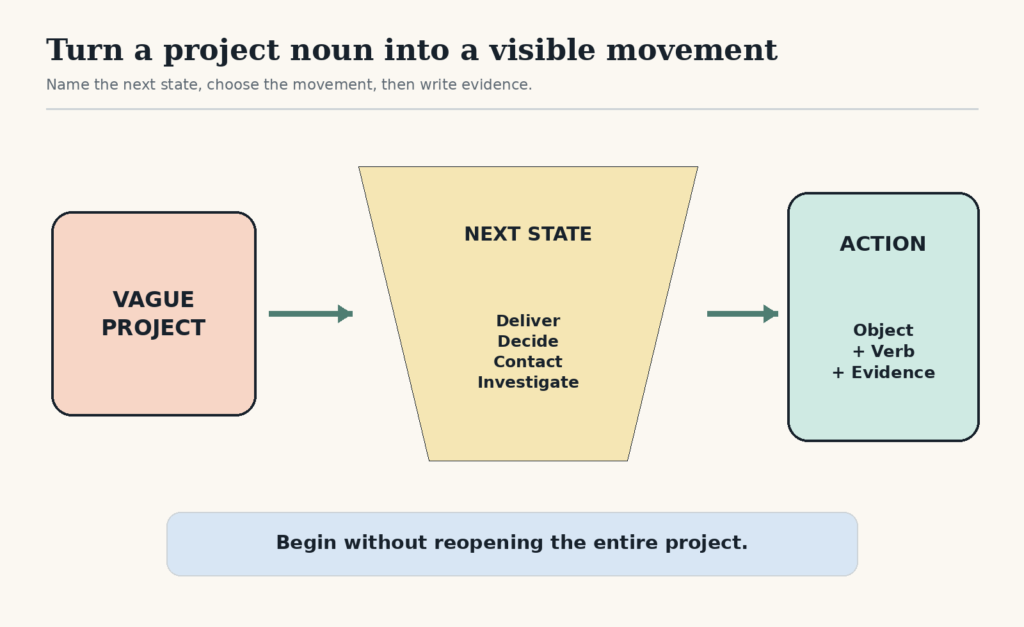
Choose one of four movement types
- Deliver: create or change an object—draft, file, page, room, form, or list.
- Decide: choose among bounded options using named criteria.
- Contact: send a request that makes another action possible.
- Investigate: answer one question with a defined evidence limit.
“Research website platforms” has no finish. “Compare WordPress and Squarespace on recurring cost, editing access, and checkout requirements; record one recommendation” has a question, criteria, and evidence.
Write the action as object + verb + evidence
In or with this object, perform this visible verb, until this evidence exists.
Examples:
- In the lease folder, find the renewal deadline and place it on the calendar.
- With the three venue quotes, compare capacity and total cost and mark one preferred option.
- In the draft lesson, write the example that demonstrates the main claim.
- Using the clinic portal, request the itemized receipt and record the follow-up date.
Avoid verbs that hide several decisions: handle, work on, organize, deal with, improve, and figure out. They can appear in project descriptions, but the next action needs a more visible verb.
Expose a missing decision
If every action still branches, the real next movement may be a decision. Write the options and the smallest criteria that matter now.
| Vague project | Hidden decision | Visible next action |
|---|---|---|
| Redo bedroom | What function must improve first? | Choose sleep, clothing access, or work surface as the first protected function |
| Launch newsletter | Who is the first reader? | Write one sentence naming the reader and problem |
| Plan trip | Which constraint leads? | Choose date, budget, or location as the fixed edge |
| Fix finances | Which unknown creates current risk? | List balances and the next due date from official accounts |
Turn a dependency into a contact action
“Waiting for contractor” may hide an unsent request. Write the smallest message that can move the project: “Email the contractor the three photos and ask for availability before 30 August.”
After the request is sent, move the item to the Waiting List with the dependency, follow-up date, and re-entry action. Do not leave it among tasks you can perform now.
Bound investigation before opening the browser
Define:
- the exact question;
- the sources appropriate to the stakes;
- the comparison criteria;
- the stopping condition.
For a low-cost desk tray, official dimensions and two or three credible product options may be enough. For legal, financial, medical, or safety decisions, use appropriate qualified sources and do not force the research into an arbitrary short window.
Example: “create course” becomes one afternoon action
Mira’s list says “create course.” She cannot tell whether to outline lessons, choose software, record video, or build a sales page.
She names the next state: “one teachable result and a five-part learner path exist.” The movement type is Deliver. The action becomes: “In a blank document, write the result a learner should demonstrate, then draft five lesson titles that lead to it.”
After 35 minutes, the course is not complete. The project has changed state. The next decision—whether each lesson needs video—can now be evaluated against a real outline.
Make the action fit the available window
If you have 15 minutes, reduce the evidence rather than replacing the project with unrelated small tasks. The 15-minute attention-window method shows how to create a closed slice and leave a return note.
If starting still feels impossible after the action is concrete, use the first-step guide to reduce entry friction without shrinking the purpose.
A next action is good when you can begin it without reopening the entire project—and when finishing it gives the project a new, visible state.
Free GentleDone resource
Overwhelmed? Start with 10 minutes.
The GentleDone 10-Minute Reset gives you one deliberately small place to begin.