
A home can be organized and still be difficult to use. The basket is attractive, the labels are clear, and everything technically has a place—but the place is two rooms away from where the object gets dropped. After a few ordinary days, the system begins producing piles again.
Low-friction home organization starts with movement, not containers. It asks where an item enters the home, where it is used, what must happen before it can be put away, and how likely that return trip is on a tired day. The aim is not to create a home that always looks finished. It is to make the useful reset easier than the accidental pile.
Begin with the route the item already takes
Choose one recurring trouble spot: keys on the kitchen counter, clean laundry on a chair, chargers moving from room to room, or unopened mail beside the door. For three ordinary days, notice four points:
- Entry: where the item first appears.
- Use: where you reach for it.
- Drop: where it lands when you stop using it.
- Return: what the current storage system asks you to do next.
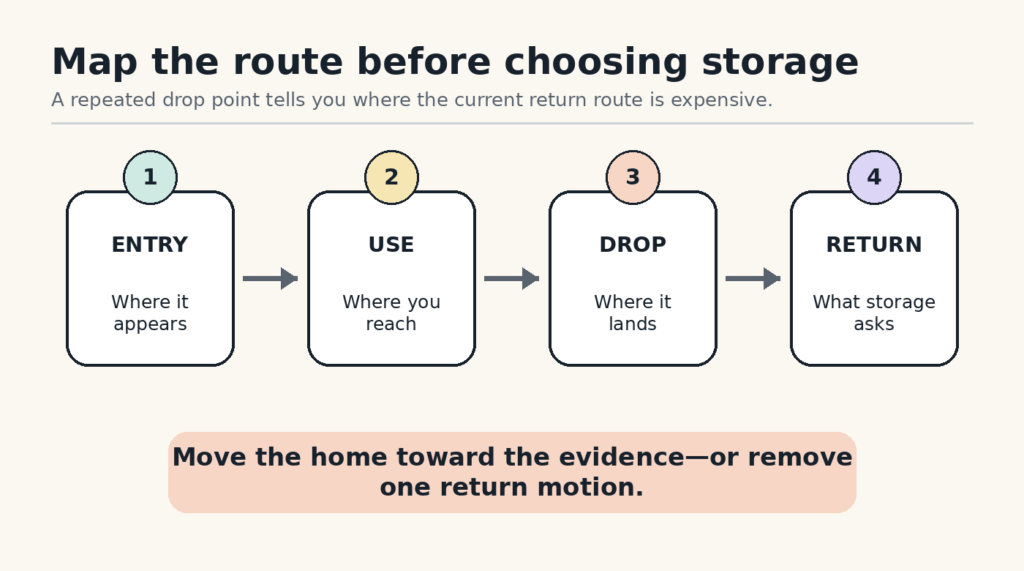
The drop point is information. It may show that the official home is too far away, hidden behind too many steps, already full, or assigned according to category rather than use. Repeated clutter is not always a sign that the household needs more discipline. It can be evidence that the route is poorly designed.
Some adults do find planning, organizing, and maintaining order unusually difficult; practical guidance from CHADD recommends keeping systems simple and working with the places where items are actually used. That principle is useful well beyond any diagnosis: a return route that matches real behavior is easier for everyone to repeat.
Put the home near the point of use
A useful home is close enough, obvious enough, and open enough for the item’s real frequency. Daily objects usually need the shortest route. Seasonal or archival objects can tolerate more distance and more steps.
Use the smallest change that removes the biggest piece of friction:
- Move the key bowl to the first stable surface after the door.
- Keep a small tray beside the chair where glasses and remotes are used.
- Place an open hamper where clothing is actually removed.
- Store the everyday pan in the easy-to-reach cabinet, even if another cabinet is the more conventional place.
- Keep a return basket at the bottom of the stairs if objects regularly need to travel between floors.
Do not reorganize the entire room to test one idea. Move one home, use it for a week, and notice whether the pile gets smaller without reminders.
Reduce the number of motions required
Every extra motion becomes a decision point: open the cupboard, pull out the bin, remove the lid, move another container, place the item, and rebuild the stack. That route may be reasonable for rare objects. It is fragile for something used six times a day.
For frequent items, prefer a one-motion or two-motion return:
- One motion: hang the bag on an open hook; drop recycling into an open bin; place shoes on a mat.
- Two motions: open one drawer and place the item inside; lift one lid and drop the item into a hamper.
Closed storage still has a role. It can protect fragile items, reduce visual noise, and keep supplies away from children or pets. The point is not to make everything visible. It is to reserve the highest-friction storage for items that can support it. Use the Open-Storage Test when you are deciding what should stay in view.
Give the busiest surfaces one clear job
A surface becomes a clutter magnet when it is both convenient and undefined. If the entry table is sometimes a mail station, sometimes a return zone, sometimes a bag shelf, and sometimes clear, every object can make a plausible claim to it.
Choose the surface’s protected function. A kitchen counter might need to preserve food-preparation space. An entry table might hold only the key tray and the day’s outgoing item. A bedside table might support sleep: lamp, water, current book, and necessary medication.
Then give arriving objects a bounded landing place rather than expecting the whole surface to stay empty. The One-Surface Rule shows how to create one legal landing zone with a visible capacity and a short closing route.
Choose the right model for items that travel
Some objects genuinely belong in more than one room. Forcing them into a single distant home can create repeated searching and stranded piles. Choose one of three models:
- Duplicate: keep an inexpensive, frequently used version at each point of use—such as charging cables, tissues, or basic cleaning cloths.
- Travel-home: keep the item in a handled caddy or pouch that moves as one unit and returns to one obvious parking place.
- Central station: store the item between its main use zones when duplication would be expensive, unsafe, or wasteful.
The detailed decision process is in How to Build a Home for Things You Use in More Than One Room.
Leave spare capacity inside the system
A container that works only when every item is arranged precisely is already close to failure. Daily systems need room for imperfect returns, laundry between loads, new groceries before the old supply is finished, and the extra object that enters the house unexpectedly.
A useful capacity rule is visual rather than mathematical: you should be able to return the normal item without rearranging the contents first. If closing a drawer requires compression or if one new piece topples a basket, reduce the category, increase the container, or split the route.
Do not buy storage before you know which of those three problems you have. A larger bin can make an overgrown category harder to see. A second bin can help when two use zones genuinely need separate homes.
Build for low-capacity days, shared homes, and real bodies
The system should still be usable when someone is carrying groceries, managing pain, moving quickly, helping a child, or finishing a long day. Keep frequently used objects within a comfortable reach. Avoid floor-level homes for items used several times a day if bending is difficult. Use large category labels or visible contents when memory is the main friction.
In a shared home, agree on a small public rule rather than a private ideal. “Keys live in this tray” is easier to share than “keep the entry organized.” If household members use the same object in different places, choose a travel-home or duplicate model instead of arguing over the one correct room.
Safety overrides convenience. Medication, chemicals, sharp tools, confidential papers, and choking hazards may need a secured home even when that adds a step. Reduce friction around the safe route—clear label, easy latch for the intended adult, nearby supplies—without removing the protection.
Run a twenty-minute pilot before a full reorganization
- Choose one pile that has returned at least three times.
- Name the object type and its real use point.
- Remove one obstacle from the return route.
- Create a temporary home with something you already own: a tray, open box, hook, or paper label.
- Use the system for seven days before buying or expanding it.
If the object still lands elsewhere, move the home toward the new evidence. If the container overflows, decide whether the category is too broad or the capacity is too small. If the item is returned but still hard to find, improve visibility or labeling. A failed pilot is not wasted effort; it tells you which part of the route remains expensive.
Repair the friction instead of restarting the room
When the system slips, reset only the broken connection. A basket full of unrelated items may need a five-minute closing route. A drawer that no longer shuts may need one category reduced. A hook that stays empty may simply be in the wrong place.
Start with the repeated movement you can already see. Give one object a closer home, one surface a protected function, or one traveling category a clear model. A low-friction home is not maintained by constant attention. It is shaped so that ordinary movement keeps returning things to useful places.