
Most focus systems are designed for an afternoon that stays put. The door remains closed, the calendar behaves, and the work block ends because the task reached a sensible stopping point. Many real days do not offer that shape.
A usable focus system needs to work when attention arrives in short windows, interruptions are partly legitimate, and the hardest moment is returning after a transition. The goal is not to defend perfect concentration. It is to keep one piece of work enterable, protect the important part while you are in it, and leave enough evidence to return.
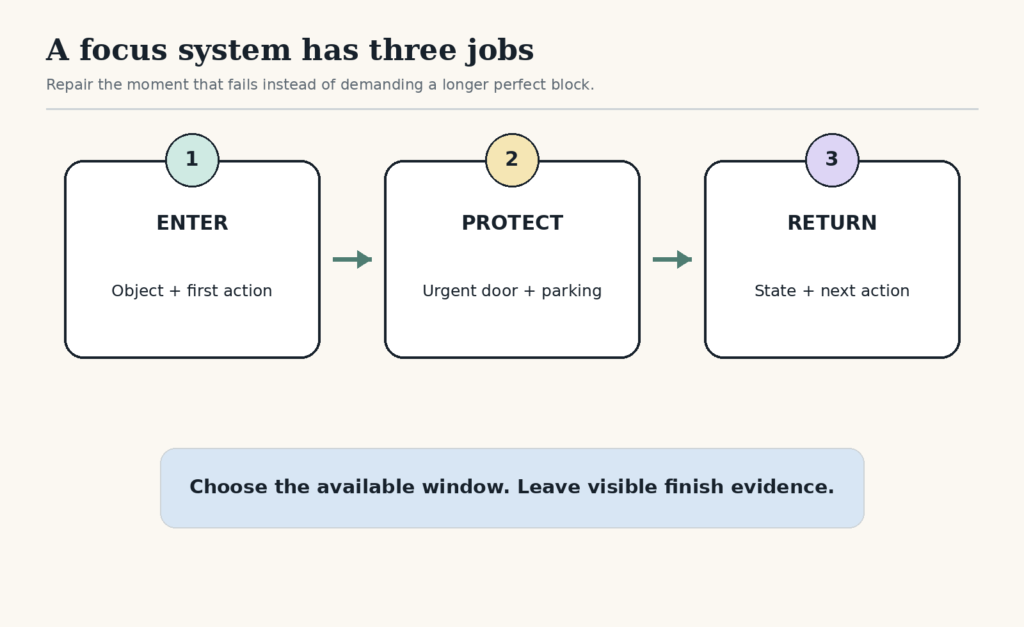
Focus has three separate jobs
“Focus” is often treated as a single ability. In practice, a working system has to support three different moments:
- Entry: know what to open and what the first visible action is.
- Protection: decide what may interrupt and where everything else waits.
- Return: preserve the state of the work before you leave it.
If one moment keeps failing, adding more time to the calendar rarely repairs it. A two-hour block still feels unusable when the first action is vague. Silence does not help when the right document is buried. A productive hour can be lost tomorrow if you close with no record of what changed.
Route work by the window you actually have
Start with the available attention window, not the ideal task duration. Use three lanes:
| Window | Useful work | Finish evidence |
|---|---|---|
| About 5 minutes | Open the source, locate the decision, write the question, or prepare the first tool | The next action is visible |
| About 15 minutes | Complete one closed slice with a clear boundary | One small output exists |
| 30 minutes or more | Build, compare, draft, calculate, or revise a meaningful section | The work changed state and has a restart note |
The short lane is not a drawer for trivial chores. It is a way to reduce the entry cost of important work. “Open the budget and identify the unexplained line” can be more valuable than answering three easy messages. For a complete short-window method, use the 15-minute attention-window guide.
Give one task the foreground
Choose one foreground task for the current window. Everything needed to perform that task may be open; unrelated choices stay out of sight. This is different from demanding one browser tab in every situation. Research, data entry, and comparison work may require several sources. The rule is one active work context, not one literal file.
A simple computer version is:
- one working window or desktop;
- one named parking note for ideas and nonurgent requests;
- one communication channel allowed only when the work genuinely requires it;
- one sentence stating what “done for this window” means.
If your tabs have become the work queue, begin with the One-Tab Rule. It separates the page you are acting on from references and parked obligations without pretending complex work needs only one source.
Build an interruption door
An interruption door is a visible rule for what gets immediate access. Write it before the block begins. For example:
Interrupt now for a safety issue, a customer outage, or a call from school. Put other requests in the shared queue. I will check it at 11:30.
This turns “please do not interrupt me” into an operating agreement. It protects real urgency and gives ordinary requests an arrival point. The rule can be different at home, in a shared office, or during care work. The important part is that the exception is concrete enough for another person to use.
Phone notifications can disrupt performance even when the recipient does not touch the phone. In a laboratory study, notifications alone significantly affected performance on an attention-demanding task. That finding does not mean every alert has the same cost in every setting, but it supports moving nonurgent alerts out of the foreground. See the original notification study.
The focus-block interruption guide helps you define urgent exceptions, a capture route, and promised response windows.
Leave a re-entry note before every transition
Before switching away, take 30 to 90 seconds to record:
- what was just completed;
- the exact next action;
- the file, page, person, or decision needed next;
- anything time-sensitive about returning.
Researchers use the term attention residue for thoughts about one task that persist after moving to another. A study of interrupted work also found that a brief ready-to-resume plan can reduce the difficulty of shifting attention to the interrupting task. These studies examine particular experimental and work contexts; they do not promise effortless switching. They do support preserving the next step instead of asking memory to hold an unfinished task. Read the attention-residue study and the ready-to-resume study.
For a dedicated handoff method, use How to Switch Tasks Without Losing the Next Step.
See the system on an interrupted morning
Nadia has 40 minutes to revise a proposal before a school call may arrive. She writes the finish evidence: “pricing section has one recommended option and two reasons.” She opens the proposal and the pricing sheet on one desktop. Messages remain closed, but the school number and her team’s outage channel may break through.
After 17 minutes, the school calls. Before answering, she writes: “Option B chosen; next compare delivery dates in rows 18–24.” The call takes the rest of the window. The proposal is not finished, but it is no longer shapeless. A later 15-minute window has an exact entry and a closed slice.
Diagnose the failing moment
- If you circle before starting, repair entry: make the first action smaller and put the needed object in view.
- If you keep reacting, repair protection: define urgent exceptions and schedule the next communication checkpoint.
- If returning takes too long, repair re-entry: leave a state note before standing up or changing screens.
- If the block is consistently too large, repair scope: define a smaller finish that can exist independently.
Change one weak point for a week before adding more machinery. A focus system is successful when important work remains reachable across ordinary interruptions—not when every hour looks uninterrupted.