

Friday night can quietly create a second job for Saturday. Laundry, groceries, cleaning, planning, errands, messages, and preparation for Monday all appear to belong to “the weekend,” so the list expands until rest becomes something you may earn after finishing it.
A weekend routine should not require a recovery marathon. It should protect some actual recovery, restore one household function, make one part of the coming week easier, and leave optional work optional.
Do not make recovery the final category
Research on recovery from work distinguishes experiences such as psychological detachment, relaxation, mastery, and control. That does not prescribe one ideal weekend or mean every person can detach fully from work, care, or financial demands. It does make one planning error visible: if every recoverable hour is pre-assigned to maintenance, there is no space left for recovery to happen. See the original Recovery Experience Questionnaire study.
Put a recovery anchor on the page before building the maintenance list. It can be a slow breakfast, an hour without errands, a walk, an afternoon nap, time with someone, worship, reading, a hobby, or simply an unassigned window. The anchor should be specific enough to protect but not so elaborate that it creates another preparation project.
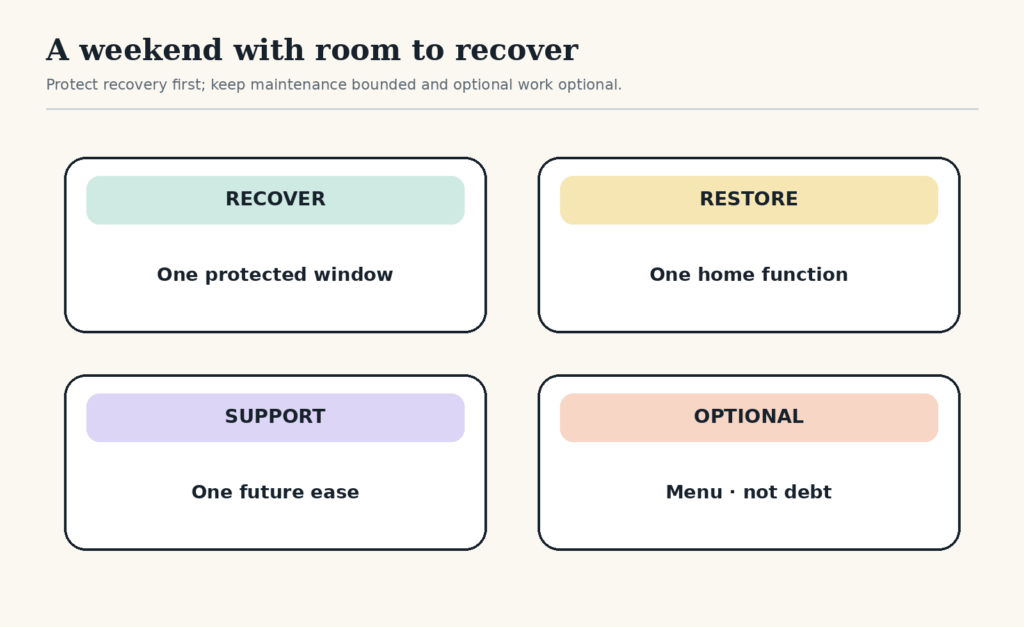
Use four zones, not one long list
Divide the weekend into four kinds of work:
- Recover: one experience that reduces demand or restores choice.
- Restore: one home function that needs to work again.
- Support: one action that makes the next few days easier.
- Optional: anything useful that can disappear without creating harm.
This is not a requirement to complete four projects. Recovery is protected. Restore and Support each receive one bounded outcome. Optional work is a menu, not debt.
Choose one home function
Do not write “clean house.” Choose the function that is creating repeated friction: clean clothes for work, a usable kitchen sink, a clear entrance, groceries for three meals, or a bathroom with essential supplies.
For example, “laundry” may mean wash the work clothes and put underwear in its bin. It does not have to include folding every item. The no-fold laundry system can help when the finishing standard is what keeps the whole route blocked.
Choose one future support
The future-support action should remove a predictable Monday obstacle. Examples include choosing Monday’s first task, refilling medication according to its existing instructions, packing a bag, checking the first appointment, preparing one backup meal, or placing a form by the door.
If the coming week feels too variable for a detailed plan, use a capacity-based planning method instead of assigning every task to an exact hour.
Choose the stop before you begin
Each maintenance block needs a finish line that can be seen. “Kitchen reset for 25 minutes” is time-bounded but may still feel unfinished. “Sink empty enough to wash one pan, counters cleared around the kettle, stop” describes the condition you are protecting.
| Vague weekend job | Bounded finish |
|---|---|
| Catch up on the house | Restore one clear food-prep space |
| Get organized | Put Monday’s bag, keys, and required paper together |
| Do all the laundry | Make one needed clothing category available |
| Plan the week | Confirm fixed commitments and choose Monday’s first action |
| Clear my inbox | Find urgent messages and schedule the next triage window |
Run the Saturday-morning test
Imagine you wake with half the energy you expected. Which parts still deserve a place?
A workable reduced version might be:
- keep the slow breakfast;
- run one load containing the clothes needed first;
- confirm Monday’s first fixed commitment;
- drop every optional task.
This reduced plan is not a failed version of the weekend. It is the version designed for limited capacity. If even that is too much, protect the consequence with the greatest cost and let the rest wait.
Example: a weekend with care responsibilities
Jon has Saturday appointments for a family member and cannot predict how long they will take. On Friday, he protects Sunday morning as an unassigned recovery window. His Restore outcome is “enough clean work clothes through Wednesday.” His Support outcome is “put Monday’s documents and lunch container by the door.”
He does not schedule a garage cleanout, pantry reorganization, and two weeks of meal prep around the appointments. Those stay on the Optional menu. When Saturday runs long, the laundry becomes one needed load and the documents remain the only future-support action. Sunday morning does not become repayment time.
When the routine needs a different boundary
If the weekend contains paid work, caregiving, a move, illness, or a deadline, the four zones may not fit neatly. Do not use them to deny the constraint. Use them to ask what small unit of control or restoration remains possible. That might be a 20-minute protected pause, ordering groceries, asking another person to own one task, or choosing what will explicitly remain undone.
If your reset routinely grows after it starts, the bounded weekly reset provides a tighter route with an exit. A weekend routine is doing its job when Monday is slightly easier and some part of the weekend still belonged to living.
Free GentleDone resource
Overwhelmed? Start with 10 minutes.
The GentleDone 10-Minute Reset gives you one deliberately small place to begin.