
Laundry rarely fails because washing clothes is complicated. It fails in the handoffs: the load stays in the washer, the dry clothes live in a basket, or folding becomes the price of having anything put away.
A useful laundry system does not require every T-shirt to be folded into a perfect rectangle. It needs to make clean clothes wearable, findable, and easy to move through the house. That is the standard here.
Define “done” before you touch the laundry
For most everyday clothes, “done” can mean clean, dry, and stored in the place where you will look for them. Folding is optional unless it protects the item, saves meaningful space, or makes the clothing easier to use.
Divide your clothes into three storage treatments:
- Hang: clothes that wrinkle easily or that you prefer to see at a glance.
- Drop into an open bin or drawer: underwear, sleepwear, workout clothes, and casual tops.
- Fold only when useful: bulky knits, items that need stacking, or anything that genuinely becomes harder to find when loose.
This removes one of the biggest hidden bottlenecks. You are no longer promising to perform the same finishing ritual for every item.
Build a four-stop path
A load should have an obvious next location at every stage. Set up four stops: dirty, washing, dry, and away. The containers do not need to match. A hamper, machine, clean basket, and a few labeled drawers are enough.
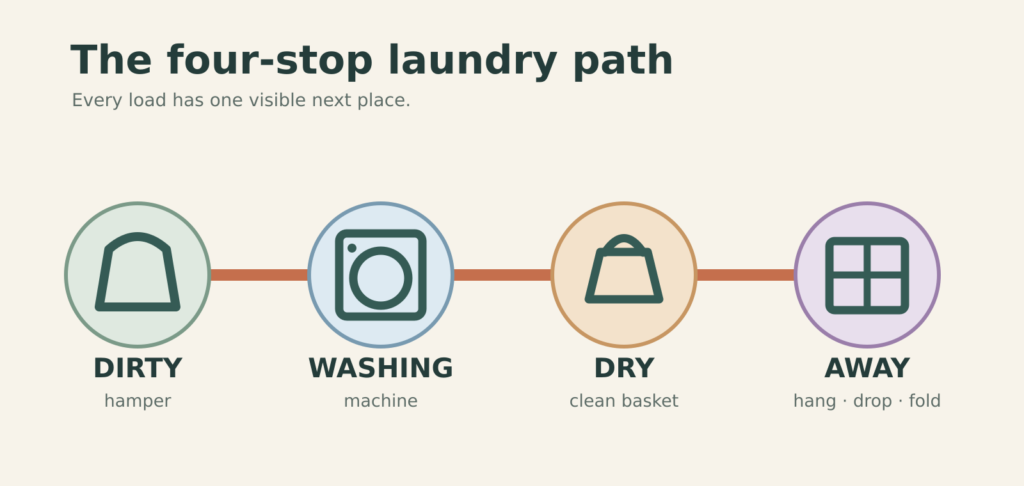
Keep the clean basket different from the dirty hamper. If the same basket does both jobs, a half-empty clean load can quietly turn back into mixed laundry. A visual difference—a different color, shape, or location—is enough.
Place the clean basket where clothes are actually stored, not automatically in the laundry room. The closer it is to the final destination, the less likely “put away” becomes a separate expedition.
Use one sorting rule, not seven
Complex sorting systems are easy to abandon. Start with the smallest set of categories your clothes actually require. Many households can run with everyday clothes, towels and bedding, and special-care items.
Before washing something unfamiliar, check its label. The Federal Trade Commission’s guidance explains that clothing care labels provide washing or dry-cleaning instructions, including relevant drying and temperature information. Following the label is safer than assuming one setting works for everything. See the FTC’s care-label guidance.
For ordinary, suitable loads, cold water is often a practical default. ENERGY STAR notes that cold-water washing generally uses less energy and recommends full loads when possible. “Full” means the clothes still have room to move; it does not mean forcing in one last towel. Review the ENERGY STAR washer guidance, then follow your machine and garment instructions.
Make the handoffs harder to miss
The washer and dryer cannot tell whether you are busy, tired, or in another room. Give each load one external cue.
- Start a timer when the washer starts. Name it “move laundry,” not simply “timer.”
- When you move the load to the dryer or rack, start a second timer called “collect laundry.”
- Carry the clean basket to its storage area immediately, even if you will put items away later.
If you cannot respond when a timer goes off, reset it for a real time rather than dismissing it. The system only needs to preserve the next handoff.
Use a two-pass put-away
Do not make yourself finish the hardest items first. On the first pass, remove everything with an effortless home: underwear to its drawer, towels to the shelf, shirts to the open bin. On the second pass, hang or fold the few items that need it.
If the second pass does not happen, the majority of the load is still away. That is a functioning system, not a failed version of a perfect one.
Match the load to the day you have
Low-capacity day: wash only the items needed for the next two days. Move them through the full path. A small completed load is more useful than three sorted piles.
Ordinary day: run one full category and put away the easy items before beginning another load.
Restart day: stop adding new loads. Rescue what is already wet or dry, empty the machines, and restore the four stops. Then choose tomorrow’s first load.
If laundry regularly appears during your planning session, give it one bounded place in your weekly reset rather than scattering vague “catch up on laundry” reminders across the week.
Fix the point where your system jams
| What keeps happening | Change this part |
|---|---|
| Wet clothes stay in the washer | Use a named timer and keep the next machine or drying rack clear before starting. |
| Clean clothes live in a basket | Move the basket beside storage and use open bins for everyday categories. |
| Loads become too large to finish | Make the hamper’s capacity the load limit, or wash one category at a time. |
| Special items derail sorting | Give them one small “check label” bag and process it separately. |
Set it up in ten minutes
- Choose a dirty hamper and a visibly different clean basket.
- Pick three storage treatments: hang, drop, or fold when useful.
- Clear the washer and dryer or drying rack.
- Create two named timer labels on your phone.
- Run one needed load all the way through the path.
The aim is not to become a person who loves folding. It is to remove the unnecessary decisions between “this needs washing” and “I can wear this.” Once those handoffs are visible, laundry becomes a short route instead of a recurring rescue operation.
Free GentleDone resource
Overwhelmed? Start with 10 minutes.
The GentleDone 10-Minute Reset gives you one deliberately small place to begin.