
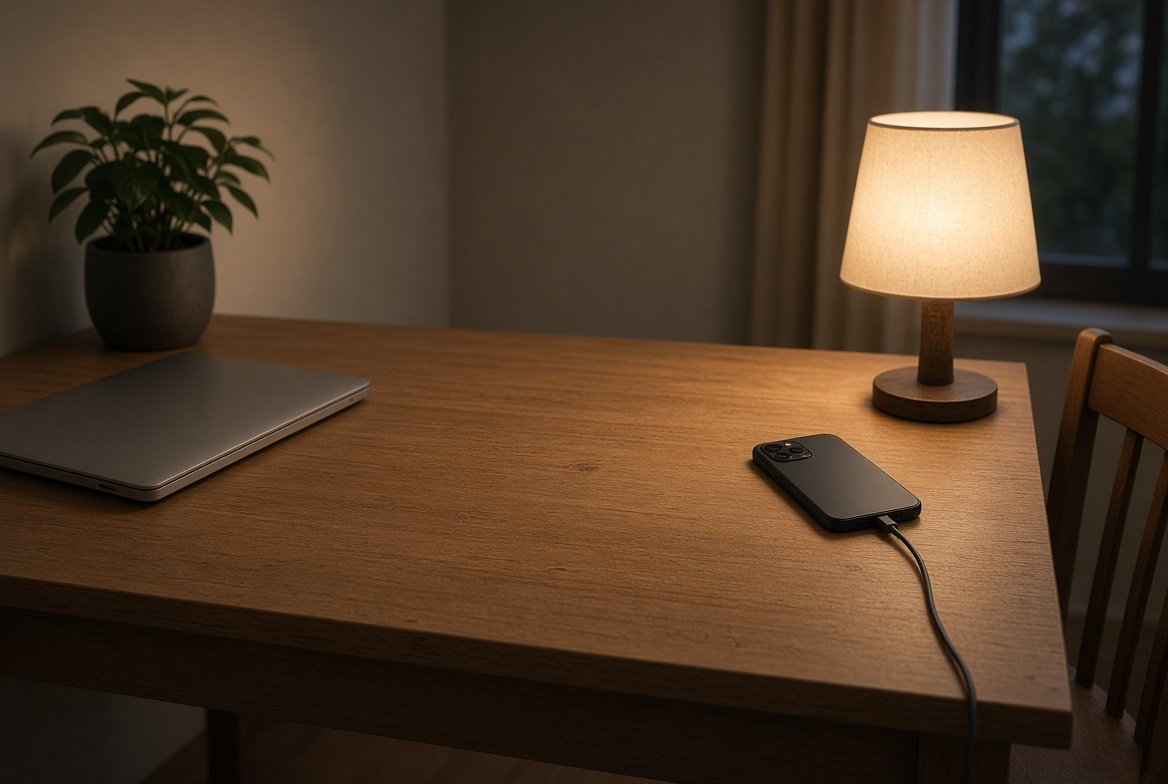
Most evenings don’t end. They just fade.
You close the laptop or leave work, but the open loops stay open. A half-finished thought keeps circling. The kitchen looks like it belongs to someone else. Tomorrow already feels heavy before you’ve even slept.
A lot of evening routines try to fix this by asking for more. More steps. More intention. More energy you don’t have left. When the routine is too big, it becomes another thing that fails — and the failure itself adds weight.
This reset is built the other way around. It is deliberately small. It is designed for the nights when capacity is almost gone. And it includes a clear path back when you miss it completely.
Why most evening systems fail
Typical evening routines collapse for three predictable reasons.
They are too long. Ten or fifteen minutes of “proper” wind-down sounds reasonable in the abstract. On a low-energy night it feels like another shift.
They require decisions at the worst possible time. “What should I do first?” becomes its own source of friction when you are already tired.
They create catch-up debt. Miss one night and the next evening now carries yesterday’s unfinished list plus today’s. The restart cost becomes higher than the original routine.
The result is familiar: you skip it, feel slightly worse, and the system quietly dies.
A useful end-of-day system has to survive the exact conditions that usually kill it.
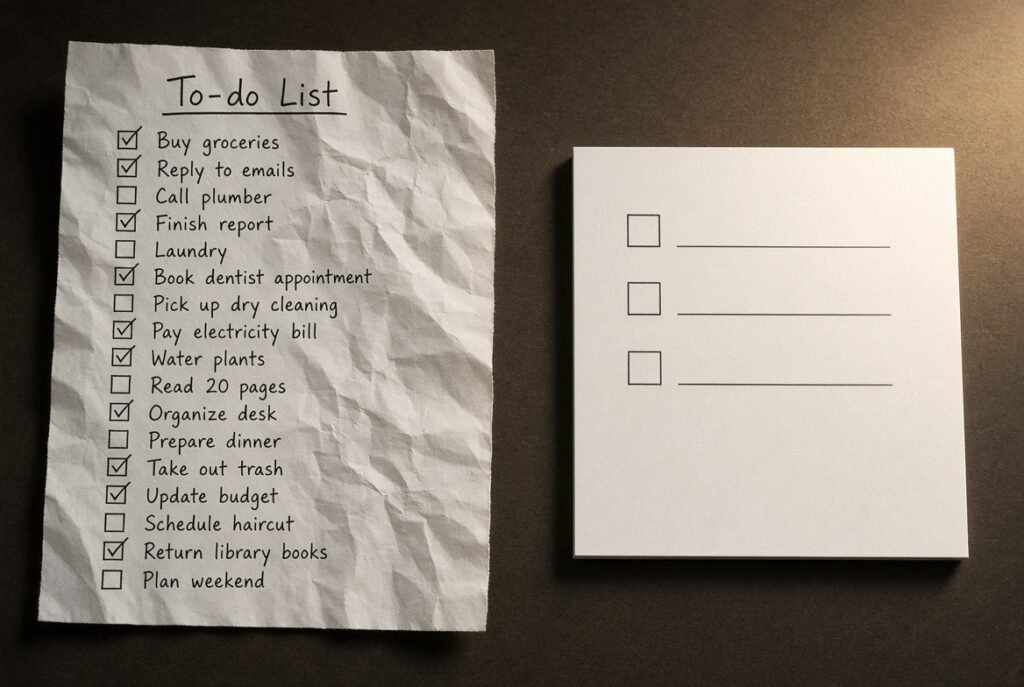
The GentleDone End-of-Day Reset
The goal is not a perfect evening. The goal is a lighter morning and a clearer boundary between “work is still open” and “work is closed for now.”
Three things matter:
- Get open loops out of your head and into a place you trust.
- Make tomorrow’s first action obvious and ready.
- Give yourself a consistent closing signal.
Everything else is optional.
Why capture and closure can help
There is a useful research-backed idea here, but it is more specific than the popular “unfinished tasks always stay stuck in your brain” version of the Zeigarnik effect.
In a series of experiments, Masicampo and Baumeister found that unfulfilled goals could produce intrusive thoughts and interfere with unrelated tasks; when participants made specific plans for those unfinished goals, those cognitive effects were reduced. A 2025 meta-analysis adds an important caution: it found no universal memory advantage for unfinished tasks, although interrupted tasks did show a general tendency to be resumed. In other words, the evidence supports making a concrete plan for unfinished work much better than it supports the blanket claim that every unfinished task is automatically remembered more strongly.
That is why this reset asks for one specific next action rather than a giant end-of-day brain dump. The aim is to give unfinished work a clear place to resume. Read the plan-making study and the 2025 interruption meta-analysis.
Separate work-recovery research also finds that psychological detachment from work is associated, on average, with lower exhaustion, better sleep and higher well-being. That does not prove that dimming a lamp, plugging in a phone or saying a closing phrase causes those outcomes. GentleDone uses those actions as simple environmental cues for marking the transition from “work is open” to “work is closed for now.” See the detachment-from-work meta-analysis.
The system is structured in three levels so it can shrink when needed and still count.
Minimum / Normal / Restart
Minimum (3–5 minutes)
This is the version for the nights when you have almost nothing left.
- Dim one light or switch to a lamp.
- Write tomorrow’s single first action on a sticky note or in a note app and put it where you will see it.
- Put the phone on its charger in its usual spot.
- Say or think one short closing phrase (“Day’s done” or “Shutdown complete”).
That is enough. No cleaning. No full brain dump. No extra steps. The Minimum still reduces tomorrow’s start cost and draws a clear line.
Normal (8–12 minutes)
When you have ordinary low-evening capacity, expand slightly.
- Do the Minimum.
- Capture any open loops in one place (a running note or task app). Just get them out of your head — no organizing or prioritizing required.
- Clear one small surface (desk corner, kitchen counter edge, or the chair that collects clothes).
- Stage tomorrow’s first physical item if it helps (clothes, bag, water glass).
The Normal version still stays short on purpose. The timer is a feature, not a suggestion.
Restart
Missed a night (or several)? Do not try to catch up.
The Restart is one visible action:
Put tomorrow’s first-action note in its place and charge the phone.
That single step re-enters the system. You do not need to recreate the routine for the nights you missed. Starting again is deliberately cheap.
| Level | Time | Core actions | Purpose |
|---|---|---|---|
| Minimum | 3–5 min | Dim light, one next-action note, phone on charger, closing phrase | Boundary + lighter morning |
| Normal | 8–12 min | Minimum + open-loop capture + one surface + optional staging | Reduce mental and physical noise |
| Restart | < 1 min | Place the next-action note and charge the phone | Re-enter without replaying missed days |
How to set it up once
Do this setup on a day when you have a little capacity. It only needs to happen once.
-
Choose your hard-stop signal.
Something environmental and obvious: closing the laptop and moving it out of sight, switching the main light off, or putting on a specific pair of soft clothes. The signal should be physical so you do not have to decide whether the day is over. -
Decide where tomorrow’s first action lives.
One consistent place. A sticky note on the bathroom mirror, a single note at the top of your phone’s notes app, or a small card on the kitchen counter. Visibility beats memory. -
Pick your closing cue.
A short phrase you say (out loud or in your head) or a small physical action (plugging the phone in, turning off the last lamp). Keep the cue the same so you do not have to invent a new ending each night. -
Optional but useful: create a simple launch pad.
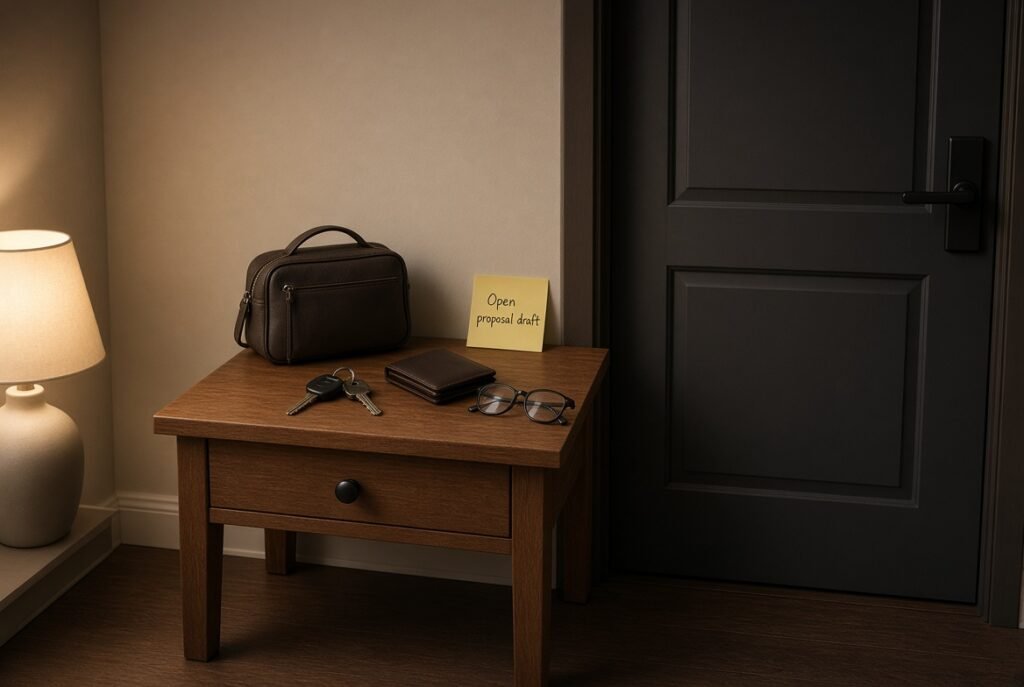
One surface near the door or by the bed where keys, wallet, bag, and the next-action note live. Loading it at night removes the morning search.
Once these four pieces exist, the daily reset becomes mostly mechanical.
What usually causes collapse (and how to notice early)
The system usually starts to fray in the same places.
The Normal version slowly grows. You add “just one more thing” until it no longer fits a tired evening. Notice when the reset starts taking longer than twelve minutes and deliberately cut it back.
The Minimum gets skipped because it feels “too small to matter.” On those nights the Minimum is exactly what matters. Doing the tiny version still protects the restart path.
The next-action note becomes vague (“work on project”). Make it concrete enough that tomorrow-you knows the first physical step (“Open the draft and write the first sentence”).
When any of these patterns appear, return to the Minimum for a few nights. The system is allowed to shrink. That is the point.
The reset is allowed to stay small
An end-of-day reset is not about becoming a different person by morning. It is about refusing to carry the entire unfinished day into the evening and then into the next morning.
On good nights the Normal version leaves the space and the mind a little clearer. On hard nights the Minimum still draws a line and places one useful thing where you will see it.
Either way, you get to stop.
And when you miss it, the Restart is waiting — one note, one charger, and no routine backlog to repay.
Free GentleDone resource
Overwhelmed? Start with 10 minutes.
The GentleDone 10-Minute Reset gives you one deliberately small place to begin.