

A routine can feel strangely distant after one missed week. The objects are still there and the steps are still known, but beginning again seems to require an apology, a new tracker, and enough effort to recover every missed day.
Skip the recovery project. Restart the smallest cue-and-action pair that made the routine easy to enter.
Do not audit the missing week
Unless the gap created a real deadline, safety issue, or financial consequence, you do not need a detailed explanation before resuming. Identify only what affects the restart:
- Does the old cue still occur?
- Is the first action still small enough?
- Did the environment change?
- Is there a backlog that must be separated from the recurring routine?
A missed week of tidying does not mean the returning routine must clean a week of mess. Backlog is a separate project. The routine’s first job is to happen again.
Find the routine’s entry action
The entry action is the first observable movement, usually under two minutes. Examples:
- put the walking shoes beside the door;
- open the planning page and write today’s date;
- place the empty laundry basket beside the washer;
- clear one section of the kitchen counter;
- open the language lesson and complete one prompt.
Do not choose “get organized” or “return to exercise.” Those are directions, not entry actions.
Reconnect the action to a cue that still exists
Habit research describes how repeated responses become associated with recurring contexts. A cue can be a place, a preceding action, an object, or another stable feature—not only a clock time. See the review on the psychology of habit.
Choose a cue you are already likely to encounter:
- after placing the breakfast cup in the sink;
- when the laptop connects to the work monitor;
- after returning the keys to the entryway tray;
- when the evening alarm sounds;
- after changing into home clothes.
If the old cue disappeared—a commute ended, a class moved, or another person’s schedule changed—rebuilding around it will keep failing. Attach the entry action to a context that belongs to your current week.
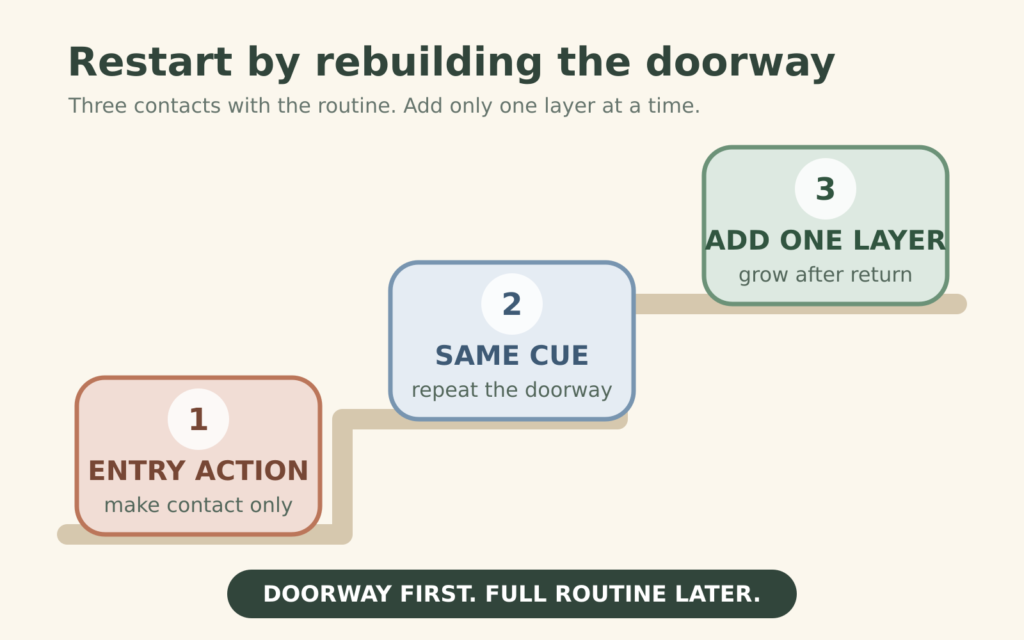
Use a three-contact restart ramp
First contact: perform only the entry action and the smallest useful version. Stop while the route still feels clear.
Second contact: meet the same cue and repeat the same small version. Do not add a reward for “making up” the gap or a penalty for staying small.
Third contact: repeat the entry, then add one normal layer if capacity and time allow. Keep the small version valid for future difficult days.
The contacts do not have to be three consecutive calendar days. They need to occur at the routine’s real frequency.
Treat a miss as data, not erasure
In one real-world habit-formation study, time to reach high automaticity varied widely, and missing one opportunity did not materially affect the modeled process. One missed opportunity is not the same as missing a full week, and the study covered a limited set of chosen behaviors, so it cannot promise that every routine remains unchanged. It does challenge the idea that one miss automatically sends progress back to zero. Read the study on habit formation in the real world.
After a longer gap, assume the route may feel less automatic. That calls for a smaller entry and a visible cue, not a dramatic restart ceremony.
Separate the recurring action from its backlog
Suppose the routine is a Friday money check and you missed two Fridays. Restart by opening the accounts and checking current balances. Schedule any overdue reconciliation as a separate task.
Suppose the routine is a ten-minute room reset. Restart with today’s floor and main surface. Put the accumulated donation boxes or paperwork on a separate project list.
This boundary prevents the routine from becoming harder each time it is missed.
Change one variable when the restart fails
| What happens | Change one thing |
|---|---|
| You forget until much later | Move the cue into your path or attach it to a preceding action. |
| You begin but avoid the full version | Keep the small version and remove one optional layer. |
| The backlog takes over | Create a separate recovery task with its own limit. |
| The old time no longer works | Keep the action but choose a current, recurring context. |
| You restart several routines at once | Choose the one that restores the most useful daily function. |
Choose proof that does not depend on a streak
Record the most recent completion date, the cue used, and the next small version. A streak counter can be motivating, but it can also make one blank day look like the destruction of everything before it.
If the routine needs to flex with changing capacity, place its small version in your capacity-based daily plan. If it is an evening close, borrow the bounded versions from the end-of-day reset.
For the next occurrence, make one promise: when the cue appears, perform the entry action. The routine can become larger after it becomes reachable again.
Free GentleDone resource
Overwhelmed? Start with 10 minutes.
The GentleDone 10-Minute Reset gives you one deliberately small place to begin.