

Planning tomorrow can become a second workday: review every project, rewrite the list, rearrange the calendar, estimate each task, and still wake up unsure where to begin.
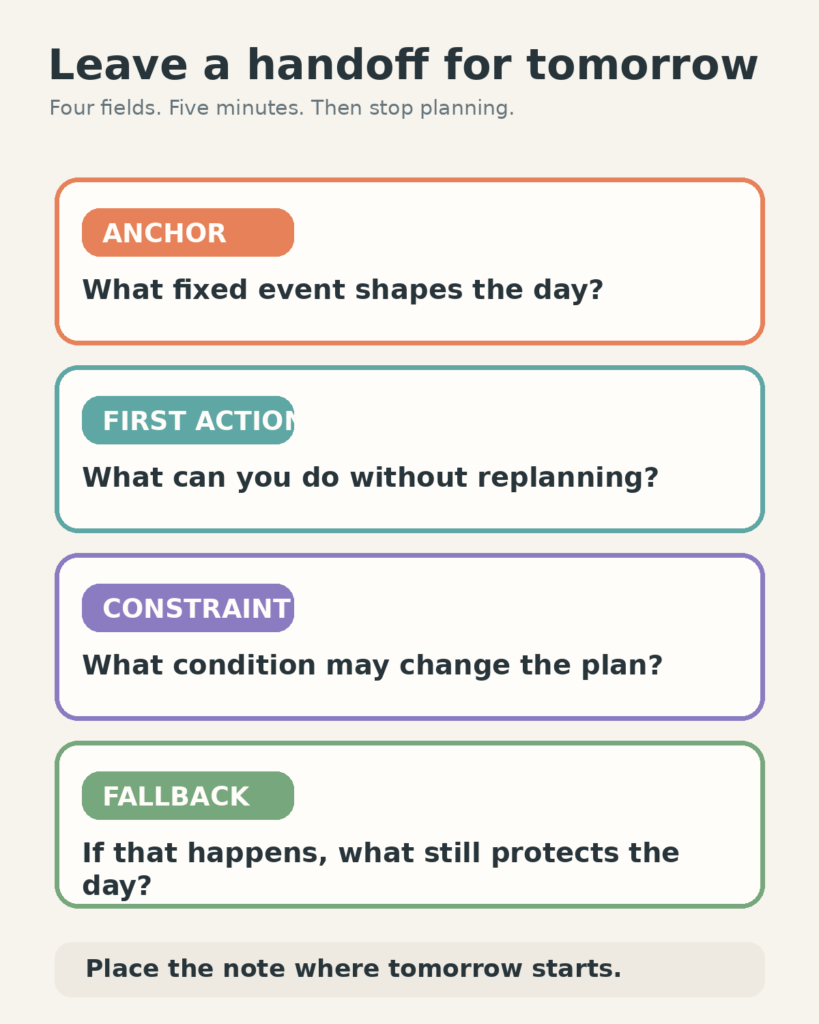
A five-minute handoff does less. It leaves four pieces of information that make tomorrow easier to enter: one anchor, one first action, one constraint, and one fallback.
Record one anchor that shapes the day
The anchor is the fixed event, deadline, or responsibility that other decisions need to respect. It might be a 9:30 call, a school pickup, medication timing, a delivery window, or a report due before 16:00.
If tomorrow has several fixed commitments, record them on the calendar and choose the one that most affects the work around it. The handoff is not a duplicate calendar.
Leave one visible first action
Write the first action you can perform without reopening the entire planning process. “Work on presentation” is too broad. “Open the deck and rewrite the decision slide” gives you a place to make contact.
If the action still creates resistance, reduce it further using the Contact-Step method: open, place, name, or preview before doing.
Name the constraint before it surprises the plan
A constraint is a condition that changes what can realistically happen. Examples include a late start, travel, a required response from someone else, a noisy location, limited access to a file, or only thirty minutes between appointments.
Write the constraint as information rather than a complaint: “The revised numbers may not arrive before noon,” or “Deep-focus work is only possible before the train.” This makes the next decision clearer.
Choose a fallback that still protects the day
The fallback answers: if the original version does not fit, what smaller action still reduces risk or preserves the next start?
A concrete if-then fallback can make the handoff easier to use. The National Cancer Institute’s overview of implementation intentions summarizes evidence that situation-linked plans can help translate an existing intention into action. It is not a guarantee, and the fallback still needs to fit the real conditions.
Examples:
- If the numbers do not arrive, send the finished narrative and flag the two open fields.
- If the morning appointment runs late, move the optional errand and protect the medication pickup.
- If focused writing is not possible, gather the source notes and leave the next heading ready.
Complete the handoff in five minutes
- Check tomorrow’s calendar for fixed commitments.
- Write the anchor.
- Choose one meaningful outcome and its first visible action.
- Name the constraint most likely to change the plan.
- Write one if-then fallback.
- Place the note where tomorrow’s start will happen, then stop.
The stop matters. Do not use the remaining evening to solve every possible variation.
See the handoff for a real Thursday
Anchor: client call at 10:00.
First action: open the proposal and check the three figures highlighted in orange.
Constraint: the finance reply may not arrive before the call.
Fallback: if the reply is still missing at 9:30, send the client the confirmed sections and state when the remaining figures will follow.
This handoff does not schedule the whole day. It removes the first round of interpretation and exposes the dependency before it becomes a surprise.
Do not turn the handoff into an ideal-day plan
The page is drifting when it contains a full project inventory, an hour-by-hour schedule with no margin, several fallback levels for every task, or a promise to complete all unfinished work from today.
Move broader decisions into the Today, Soon, and Not Now system. Use the Capacity Day Planner tomorrow, after you can see which lane fits. The handoff should remain small enough to create even when you are ready to stop.
Use a sixty-second version on difficult evenings
Check the first fixed event. Write one line: “After ___, I will ___.” Place the needed file, bag, medication, form, or tool where the action begins. That is the whole handoff.
If you miss several evenings, do not recreate them. Make a new handoff from the current stopping point. Tomorrow only needs a usable entrance, not proof that every previous day was properly closed.
Free GentleDone resource
Overwhelmed? Start with 10 minutes.
The GentleDone 10-Minute Reset gives you one deliberately small place to begin.