
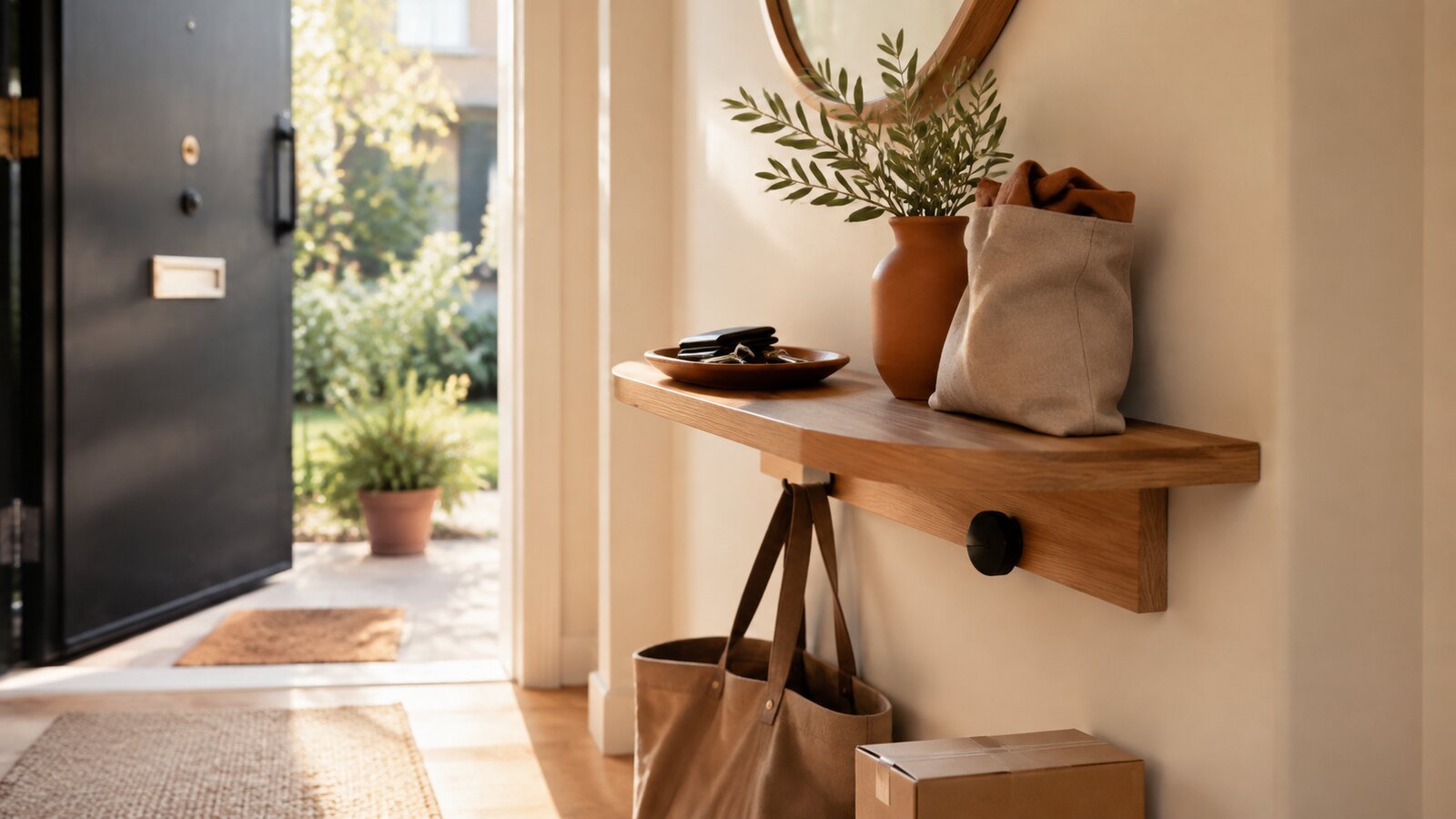
The most frustrating search for keys usually happens when there is no time to search. You check yesterday’s coat, the kitchen counter, the bag you did not take, and finally the place you already looked twice.
An entryway launch pad solves a narrower problem than “organize the hall.” It gives the items that leave with you one reliable landing place and one reliable takeoff place. You do not need a separate room, matching furniture, or a beautiful row of baskets.
Choose the first easy landing point
Stand where you naturally enter your home with your hands full. Notice the first surface or wall you can reach without changing direction. That is the best candidate for the launch pad.
The right location is on your path, not where an organizing photo says it should be. A hook around a corner may look tidy and still be too easy to skip. A small tray beside the door may work better because it catches the item at the moment you release it.
If your door opens directly into a kitchen, bedroom, or living area, use a narrow strip of wall, the end of a shelf, or the back of the door. The system needs a boundary, not a formal entryway.
Give each leaving item one visible home
Start with the things you most often search for. Usually that means keys, wallet, bag, work pass, glasses, headphones, or a child’s school item. Assign one home to each item:
- a hook for keys or a bag;
- a shallow tray for wallet, glasses, and earbuds;
- an upright slot for outgoing papers;
- a small open bin for returns or items that must leave tomorrow.
Open storage matters here. A lid, tight drawer, or crowded cupboard adds an extra action exactly when your hands are occupied. CHADD’s practical organizing guidance likewise suggests keeping a basket or hooks by the door for keys, a wallet, or a purse. See its advice on organizing a first living space.
Separate arrival from departure
Use two small zones within the launch pad:
- Home again: permanent items that return every day, such as keys and wallet.
- Leaving next: temporary items for the next trip, such as a parcel, library book, form, or packed lunch note.
This prevents tomorrow’s parcel from covering today’s keys. It also keeps the tray from becoming a general holding area for every object without a home.
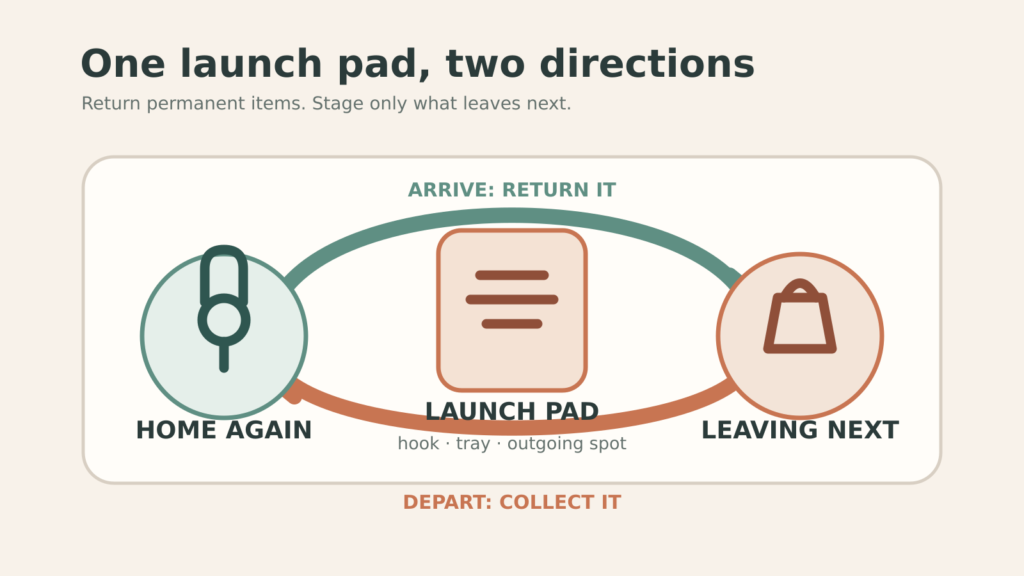
The loop works because both directions are short. On arrival, return the permanent items and drop tomorrow’s item in the leaving zone. Before departure, collect from the same two places.
Add one cue only where memory is fragile
The launch pad is already a physical cue. Add another reminder only for an item that cannot stay there, such as refrigerated food or medication stored elsewhere.
Use a cue at the point of departure: a note clipped to the bag, an empty lunch tote hanging on the door, or a phone reminder tied to the time you normally leave. Research on delayed intentions shows that people can use external reminders to support future actions; the useful principle is to place the reminder where it can trigger the action, not merely where it was created. Read the study on creating external reminders for delayed intentions.
Run the 30-second arrival loop
- Hang the keys and bag.
- Place wallet, glasses, or headphones in the tray.
- Put incoming paper in its processing spot, not on the launch pad.
- Add any item that must leave next time to the leaving zone.
If the launch pad has drifted, restore it during the five-minute version of your end-of-day reset. The job is simply to return its surface to “ready,” not to process every paper that entered the house.
Keep shared entryways understandable
In a shared household, do not rely on everyone remembering a detailed rule. Give each person one hook or one tray section. Use position or color rather than tiny labels. Keep genuinely shared items, such as a dog lead or mailbox key, in a separate central spot.
Ask one question before adding anything: “Does this item leave the house regularly?” If not, it probably needs a home elsewhere. The launch pad stays useful by remaining selective.
Repair the common failure points
| Problem | Small repair |
|---|---|
| Items land on the nearest counter | Move the tray to that counter or place it directly in the path. |
| The hook is often skipped | Lower it, move it closer, or replace it with an open basket. |
| The tray fills with unrelated objects | Limit it to named leaving items and move everything else during the daily reset. |
| You remember an item after leaving | Put a physical cue on the door handle or bag the night before. |
| Other people use your spot | Create clear individual zones instead of one undivided container. |
Build the first version in twelve minutes
- Gather the five items you most often take out.
- Choose the first reachable place inside the door.
- Add one hook, tray, or open container using what you already own.
- Divide permanent “home again” items from temporary “leaving next” items.
- Walk out and back in once to test the path.
Do not judge the setup by how it looks while empty. Judge it on a busy morning: can you see what you need, take it in one motion, and return it without thinking? That is a launch pad doing its job.
Free GentleDone resource
Overwhelmed? Start with 10 minutes.
The GentleDone 10-Minute Reset gives you one deliberately small place to begin.