

A weekly reset can begin as a kind idea—look ahead, clear a few loose ends, make Monday easier—and slowly grow into a two-hour checklist that you avoid. Once the reset tries to clean the whole house, answer every message, reconcile every account, and plan every meal, it stops being a reset. It becomes a second weekend job.
This version is a 25-minute route through five views of the coming week. You will collect decisions, not complete every task you notice.
Give the reset a finish line
Set a 25-minute timer and prepare one place to capture actions. Use paper or a digital task list, but not both during the session. Your finish line is:
- fixed commitments are visible;
- three weekly outcomes are chosen;
- the first action for each outcome is clear;
- one predictable obstacle has been reduced.
Everything else may remain unfinished. The reset succeeds when the week is easier to enter, not when your life is fully processed.
Pass one: read the calendar in both directions
Spend five minutes looking backward, then forward.
Look back seven days for anything that moved, was missed, or created a follow-up. Turn only real obligations into actions. Then scan the next two weeks for appointments, deadlines, travel, deliveries, birthdays, and preparation time.
Do not use this pass to rearrange your entire calendar. Add missing commitments and note preparation that cannot wait until the day itself.
Pass two: empty the trusted capture points
Spend five minutes on the places where loose obligations collect: your main task inbox, a paper note, starred messages, or the small pile beside your computer. Choose no more than three capture points.
For each item, decide:
- delete it because it no longer matters;
- write a visible next action;
- place it on the calendar because the time is fixed;
- move it to a someday list because it is not for this week.
The reset is not the time to perform every action. It is the time to stop vague reminders from competing with one another.
Pass three: choose three outcomes
Spend five minutes choosing up to three results that would make the week feel usefully advanced. An outcome describes a changed state, such as “submit the application,” “restock weekday lunches,” or “make the guest room sleep-ready.”
A long task list describes available work. Three outcomes tell you what deserves protection when the week becomes crowded.
For each outcome, write the smallest action that creates motion. Research by Masicampo and Baumeister found that making a specific plan for an unfinished goal reduced intrusive thoughts in their experiments. The finding is not a promise that planning removes stress, but it supports giving open loops a concrete route. Read “Consider it done! Plan making can eliminate the cognitive effects of unfulfilled goals”.
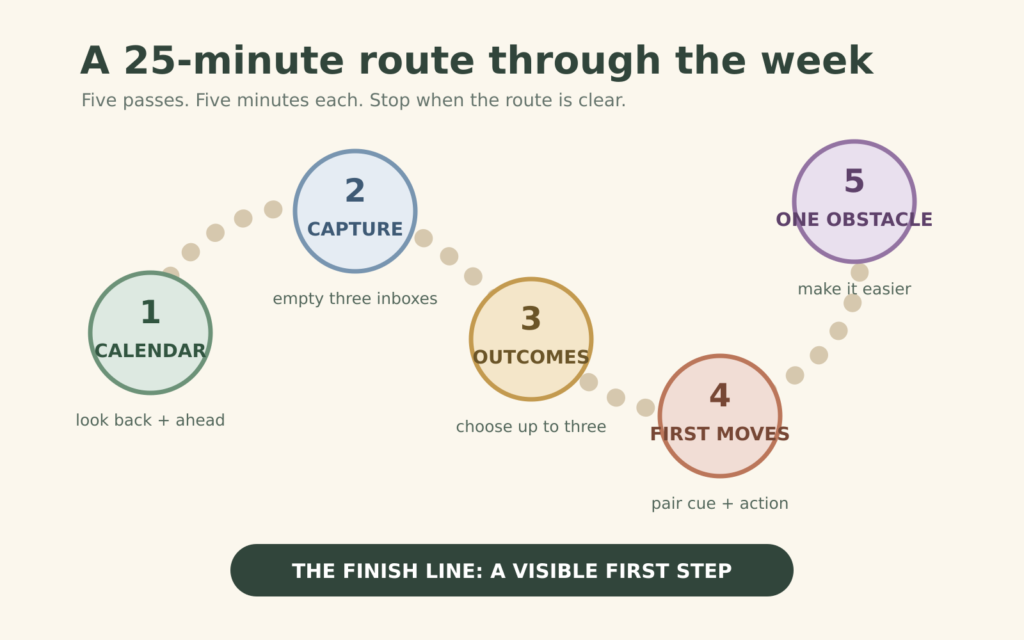
Pass four: place the first moves
Spend five minutes deciding when or where the first action will happen. Keep the commitment modest. You might write:
- “After breakfast Monday, open the application and list missing information.”
- “When I enter the supermarket, buy the five repeat lunch items first.”
- “At 6 p.m. Thursday, clear the bed and put fresh sheets beside it.”
These are if-then plans: a specific cue is paired with a response. A research review in the British Journal of Health Psychology describes how implementation intentions can help translate intentions into action. They do not remove practical barriers, so keep the first move small enough for the actual week.
Pass five: reduce one obstacle
Use the final five minutes to make one likely point of friction easier. Do not choose five. Examples include:
- put the return parcel beside your entryway launch pad;
- move one laundry load through before the workweek;
- place a needed document in the project folder;
- order one missing household staple;
- write the phone number beside the task that requires a call.
When the timer ends, stop. A reset that ends on time is easier to trust next week.
Use a smaller version when capacity is low
If 25 minutes is unrealistic, run a nine-minute reset:
- Three minutes: scan the next seven days.
- Three minutes: choose one weekly outcome and its next action.
- Three minutes: reduce the obstacle most likely to derail it.
Skip backlog cleanup. Do not try to compensate next week. The small reset is a complete version for a constrained week.
Keep the checklist from growing back
| If the reset expands because… | Use this boundary |
|---|---|
| You start doing tasks as you find them | Capture the next action and return to the current pass. |
| You review every app and notebook | Limit capture to the three places you actually trust. |
| You plan every hour | Schedule fixed commitments and the first moves only. |
| You add more weekly priorities | Keep three outcomes; move the rest to a later list. |
| You use the reset for house cleaning | Reduce one obstacle, then schedule any larger reset separately. |
Your weekly reset should leave a route, not a verdict on how organized you are. Five short passes are enough to see what is fixed, choose what matters, and give the week a visible first step.
Free GentleDone resource
Overwhelmed? Start with 10 minutes.
The GentleDone 10-Minute Reset gives you one deliberately small place to begin.