
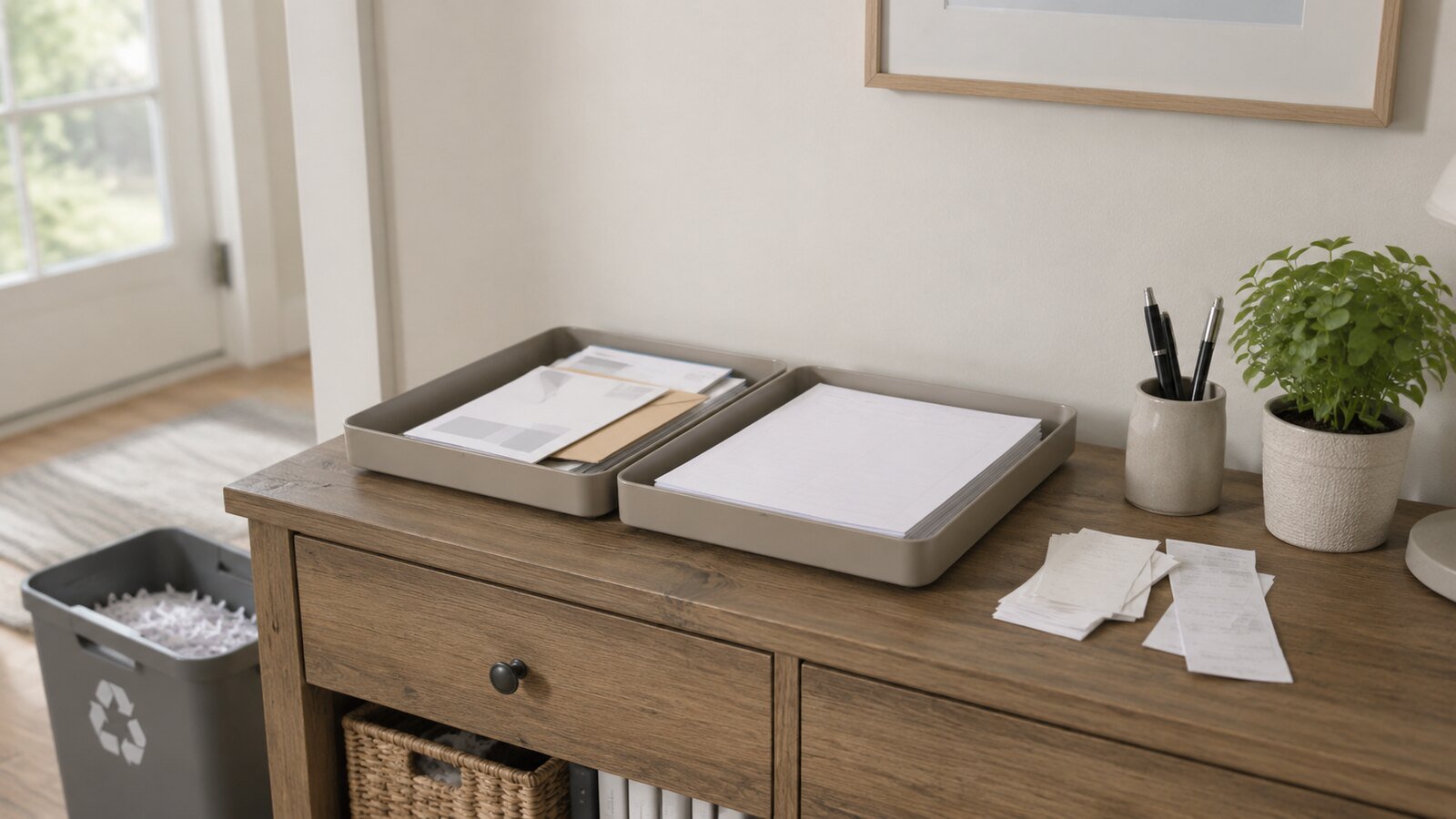
Paper clutter often looks like one pile but contains several different promises: pay this, sign that, return this package, keep this receipt, read this later. A single “paper basket” hides those differences until something becomes urgent.
Use two trays for paper that is still moving. Everything else should leave the intake area.
Name the trays Action and Outgoing
Action holds paper that requires you to decide or do something: a bill to verify, a form to complete, a receipt tied to a return, or a letter that needs a response.
Outgoing holds paper that has finished with you but still needs to leave: a signed school form, stamped envelope, return label, library slip, or document to take to an appointment.
The trays should be shallow. Deep baskets turn recent paper into archaeology. Each tray should comfortably hold one week of normal intake; overflow is a processing signal, not permission to add another container.
Give every new paper one of four destinations
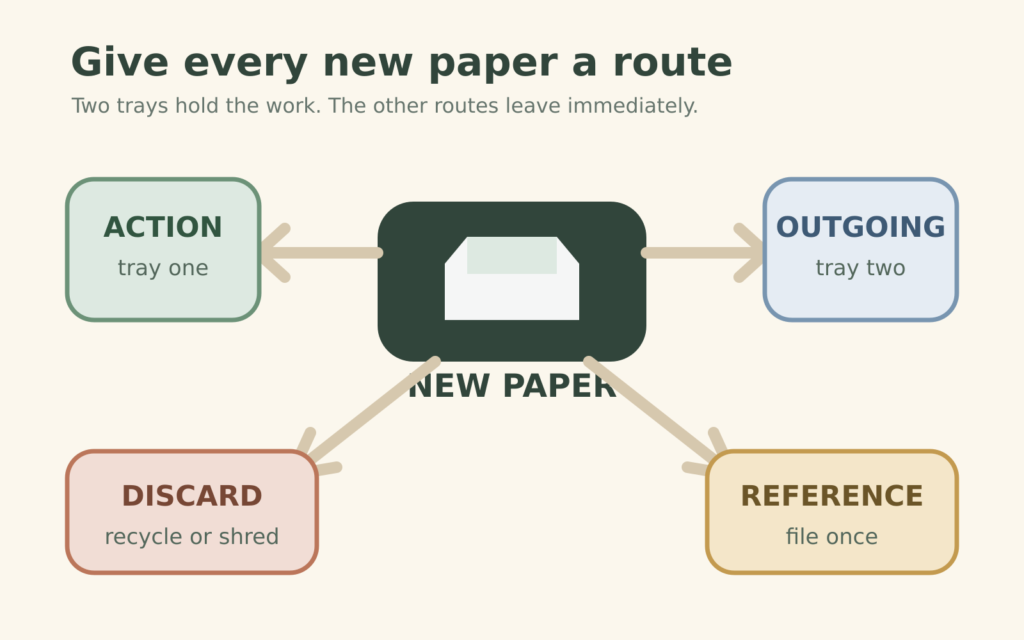
Open mail beside recycling and your secure-disposal method. Then route each item:
- Discard: recycle ordinary envelopes and unwanted inserts immediately.
- Action: place unresolved obligations in the Action tray.
- Outgoing: place completed items that must leave home in the Outgoing tray.
- Reference: file the small number of papers you have a clear reason to retain.
Do not make a “maybe” pile. If you cannot identify a current action, an outgoing destination, or a specific reason to retain a paper, it probably does not belong in the active system.
Keep receipts attached to their reason
A loose receipt is difficult to interpret later. Store it with the obligation it supports:
- Return possible: clip it to the product paperwork or place both in Action.
- Reimbursement needed: write the project or person on it and place it in Action.
- Warranty or tax purpose: file it under that exact purpose after verifying retention needs.
- No further use: dispose of it appropriately.
A photo may be enough for some ordinary receipts, but not every institution accepts a digital copy. Check the return, reimbursement, warranty, tax, or legal requirement before discarding an original.
Process Action by deadline, not by paper size
Once or twice a week, remove everything from Action and sort it into three temporary groups:
- has a date or consequence;
- needs information from someone else;
- small decision with no fixed date.
Handle the first group in date order. For the second, record what you are waiting for and put the paper back only if the original is still needed. For the third, choose one or two items; do not let undated low-value paper displace a real deadline.
When you finish an item, move it straight to Outgoing, Reference, or secure disposal. It should not return to Action as a completed paper.
Put Outgoing on the departure path
The Outgoing tray works only if it connects to leaving. Place it near the door, beside the bag you normally take, or next to your entryway launch pad.
When a paper must leave on a particular day, add a calendar reminder and move it into the bag the night before. The tray is a staging area, not the final reminder for a time-sensitive commitment.
Protect sensitive information during disposal
Some papers reveal account, financial, medical, identification, or other personal details. The FTC advises consumers to shred documents containing personal or financial information when they are entitled to dispose of them. Its guide also distinguishes examples to keep from examples to shred; see the FTC document-disposal guidance.
Do not guess at retention periods. Requirements depend on the document, jurisdiction, unresolved claim, tax situation, warranty, and institution. When uncertain, verify with the responsible organization or a qualified adviser, then file the paper with a review date rather than leaving it in Action forever.
Use a fifteen-minute pile rescue
If paper is already spread across several surfaces, do not read every page. Set out the two trays, recycling, a secure-disposal container, and one temporary reference box.
- Collect loose paper from one surface only.
- Route obvious recycling and secure disposal without detailed review.
- Place obligations in Action and completed leaving items in Outgoing.
- Put uncertain retention papers in the temporary reference box.
- Stop when the timer ends and leave the system ready for the next surface.
The temporary reference box gets a review date. It is not a third active tray.
Notice what an overflowing tray is telling you
If Action overflows, the issue is processing frequency, an unclear deadline, or too many undated commitments. If Outgoing overflows, the papers are not connected to the door, bag, mailbox, or appointment. If both stay almost empty while paper covers the counter, the intake point is too far from where paper enters.
Move the trays to the behavior. Do not demand that the behavior travel across the house to find the system.
Try it with today’s mail: discard what has no job, give unresolved paper to Action, place anything leaving home in Outgoing, and file only what has a named reason to stay.
Free GentleDone resource
Overwhelmed? Start with 10 minutes.
The GentleDone 10-Minute Reset gives you one deliberately small place to begin.