

A normal daily plan assumes that the person making it at 8 a.m. will have the same attention, pace, and patience at 2 p.m. Some days that works. Other days the calendar remains fixed while your usable capacity changes underneath it.
Plan the day in two layers: commitments that must stay visible, and a menu of work you can match to the capacity you actually have.
Anchor the day before choosing tasks
Write down the fixed points first: appointments, pickups, medication or meals you already manage, deadlines that truly occur today, and the time you need to stop. Include travel and preparation rather than recording only the event itself.
Now choose one outcome that would make the day meaningfully useful. Keep it smaller than your full project. “Send the revised proposal” is an outcome. “Work on proposal” is a category with no finish line.
The fixed points and one outcome form the frame. Everything else belongs in the capacity menu.
Build three task lanes before the day gets difficult
Sort available work by what it asks from you, not by how important it sounds.
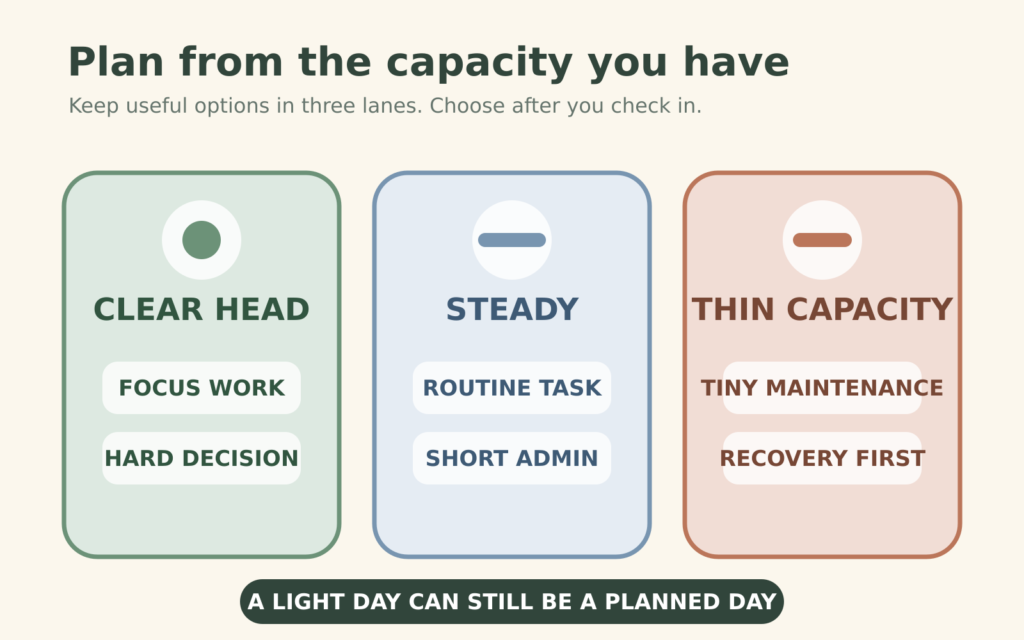
- Clear-head work: writing, analysis, complicated decisions, unfamiliar problems, or sensitive conversations.
- Steady work: familiar production, routine coordination, editing, scheduling, and concrete errands.
- Thin-capacity work: filing, gathering materials, confirming a date, renaming files, restocking, or leaving a handoff note.
Each lane needs only three to five choices. A giant “low-energy list” becomes another overwhelming backlog. Use tasks that are genuinely useful and safely stoppable.
Size the first step so it can survive a change
Large tasks are difficult to move between lanes. Give the important outcome a first step that can be completed or paused cleanly.
Instead of “prepare quarterly review,” use:
- open last quarter’s deck and mark reusable slides;
- export the three required metrics;
- write the sentence that explains the main change.
If capacity drops after the first step, leave a short note using the task-handoff method. The day can change without making you rediscover the project later.
Check capacity at transitions, not every few minutes
Constantly asking “How do I feel now?” can interrupt the work itself. Use natural transition points: after breakfast, after a meeting, after lunch, when returning home, or before the final work block.
At each transition, make one of three decisions:
- Stay in the current lane.
- Move to a lighter lane and preserve the next step.
- Stop optional work and protect the fixed commitments that remain.
No score is required. You only need enough awareness to choose work that fits the next block.
Pre-decide the fallback with an if-then rule
A fallback is easier to use when it is written before the difficult moment. Examples:
- If I cannot draft the section after ten focused minutes, then I will gather the source notes and leave the next heading ready.
- If the afternoon meeting uses the rest of my concentration, then I will move expense filing to the final block and reschedule analysis.
- If cooking feels unrealistic by 7 p.m., then I will use one meal from the backup shelf.
Research on implementation intentions describes how specific if-then plans can help connect a cue with an intended action. They cannot create energy or remove a real constraint; they make the prepared alternative easier to recognize. See the peer-reviewed review on translating intentions into action.
Protect commitments without filling every open hour
Place demanding work near the part of the day that is often—though not always—more workable for you. Learn this from a simple two-week note, not from someone else’s ideal schedule. Record only when clear-head work felt easier, ordinary, or unusually hard.
Leave margin around fixed events. A 30-minute gap is not automatically a 30-minute work block; it may be the transition time that keeps the next commitment intact.
When the day is already crowded, reduce task count before reducing every task into tiny fragments. Three half-started priorities create more restart work than one completed outcome and two clearly deferred items.
Use this example when the morning changes
Suppose the plan was to analyze survey results before lunch, handle routine messages after lunch, and buy groceries on the way home. A difficult morning arrives.
The revised day might become: export and label the survey data, leave the analysis question at the top of the file, answer only messages with today’s consequence, and order the five repeat groceries for pickup. The important project is preserved, the deadline risk is handled, and tomorrow has a visible entry point.
That is not the original plan completed at a lower standard. It is a new plan built from current constraints.
End the day without grading it
Mark what happened to the one outcome: done, moved with a next step, or no longer relevant. Return unfinished tasks to their lanes rather than carrying today’s entire list into tomorrow.
If several disrupted days have broken a recurring behavior, use a deliberate routine restart instead of asking tomorrow’s plan to recover the whole gap.
A flexible day still has structure. The structure is simply allowed to respond when your available capacity changes.
Free GentleDone resource
Overwhelmed? Start with 10 minutes.
The GentleDone 10-Minute Reset gives you one deliberately small place to begin.