
Some things refuse to belong to one room. A laptop charger follows you from the desk to the sofa. Cleaning supplies are needed in the kitchen and bathroom. Scissors migrate because the official drawer is nowhere near the package you are opening.
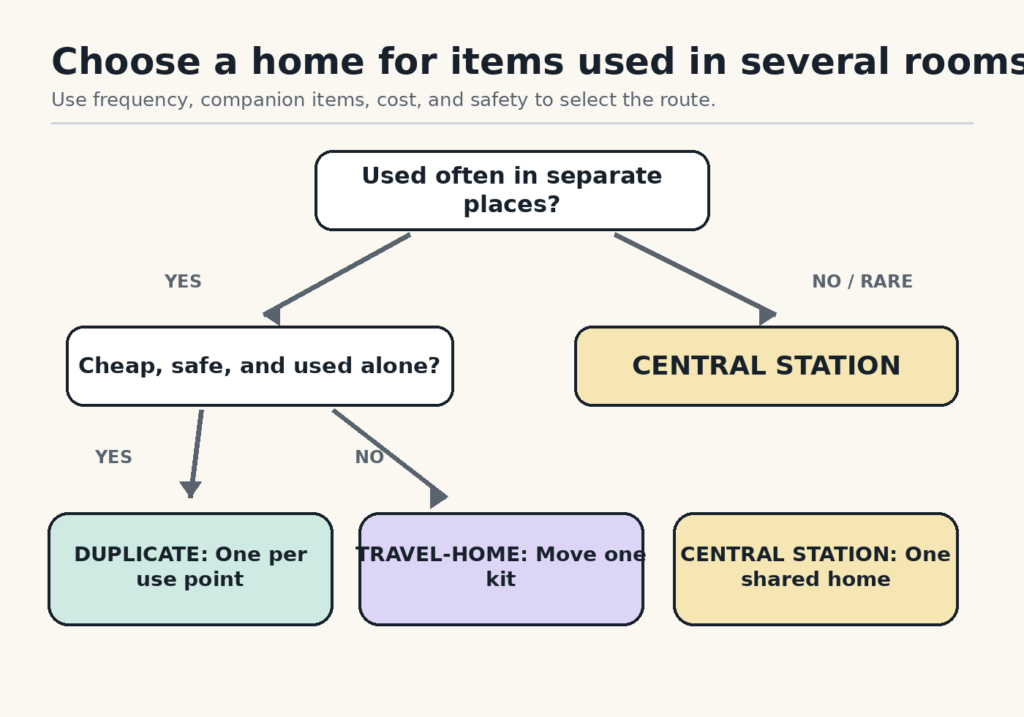
The solution is not always a stricter return rule. An item used in several places needs a storage model that accounts for movement. Choose between duplication, a travel-home, and a central station according to use frequency, replacement cost, safety, and the effort of returning it.
First confirm that the item really travels
For a week, notice where you look for the item and where it is left. A genuine multi-room item is used repeatedly in at least two places. An item that only appears elsewhere because its normal use area is blocked may need a better home in one room, not a travel system.
Ask:
- Where is it used at least weekly?
- Does it travel by itself or with related supplies?
- What happens when it is missing from one location?
- Would a duplicate be affordable and safe?
- Is the item easy to carry and easy to recognize?
Choose one of three storage models
Duplicate: one simple version at each point of use
Duplicate an item when it is inexpensive, used often in separate locations, and easy to keep safely. Basic charging cables, pens, tissues, wastebaskets, reading glasses, and cleaning cloths may qualify.
Duplicates remove the return trip, but they can also create excess. Give each copy a specific point of use. Do not buy a multipack first and then search for places to put it. Add the second copy only after the repeated route is clear.
Best fit: high-frequency items whose absence interrupts a common task.
Main trade-off: higher purchase volume and more locations to restock.
Avoid when: the item is expensive, regulated, easy to misuse, or likely to expire before both copies are used.
Travel-home: move the whole activity as one unit
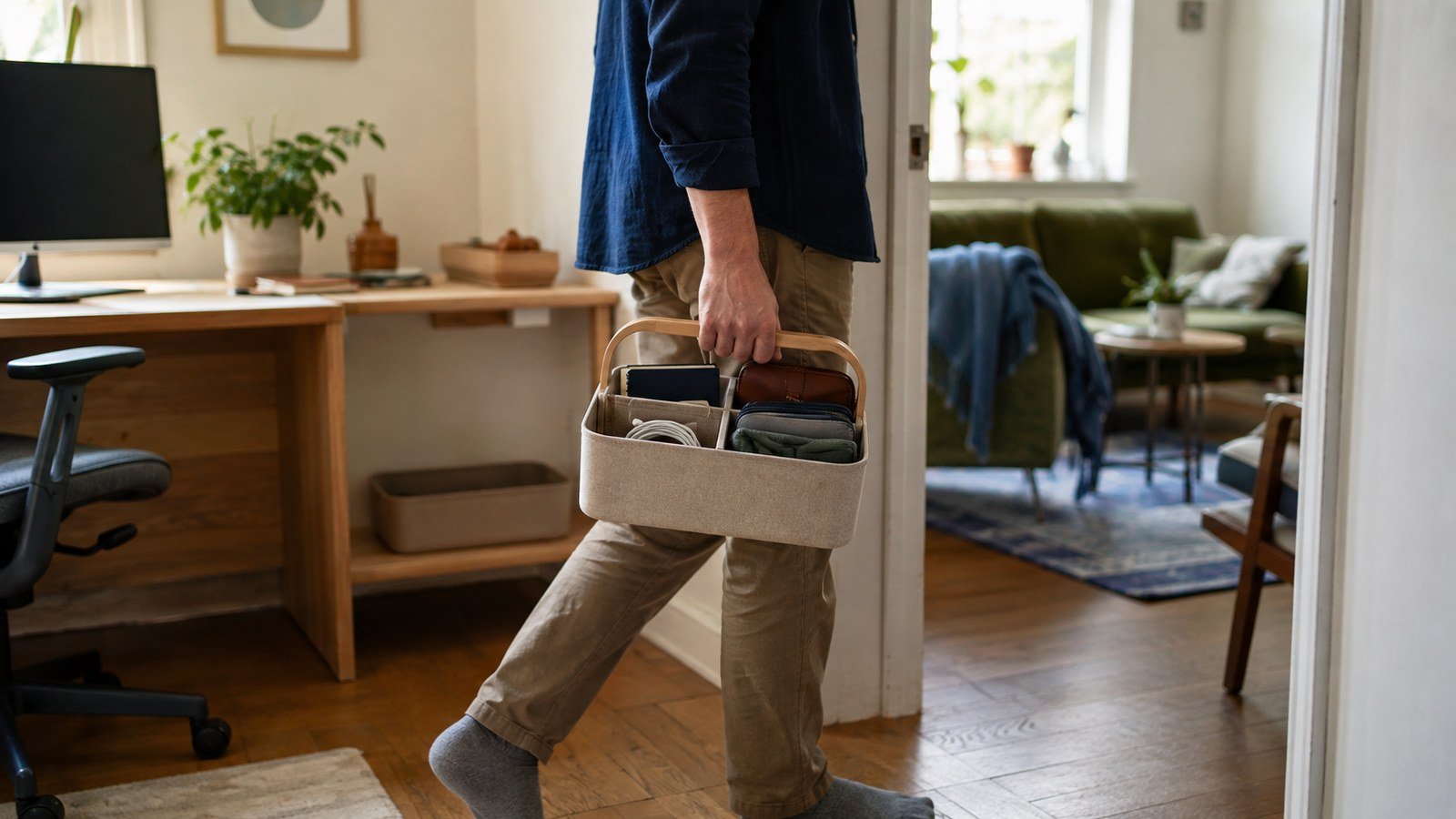
A travel-home is a caddy, pouch, basket, or case that carries the item and its companions together. The container moves to the point of use and returns to one obvious parking place.
This model works well for a small mending kit, evening hobby supplies, basic bathroom-cleaning tools, remote-work accessories, or current medication managed according to its safety requirements. A handle helps, but the container should remain light enough to carry when full.
Best fit: several related items used together in different rooms.
Main trade-off: the kit can become a miscellaneous basket unless its membership is narrow.
Avoid when: one missing component makes the activity unsafe or when the full container is too heavy for the intended user.
Central station: one home between the use zones
Choose a central station when the item is expensive, bulky, safety-sensitive, or used less frequently. Place it along the route between its main use areas—not automatically in the geographic center of the house.
A central station may hold a household toolkit, printer supplies, wrapping materials, a vacuum attachment set, or shared documents. The location should be memorable and reachable without moving unrelated objects.
Best fit: one shared item that can support a short retrieval trip.
Main trade-off: every use includes collection and return.
Avoid when: the trip is the exact reason the item is repeatedly stranded elsewhere.
Use frequency and consequence—not neatness—to decide
When two models seem possible, score the route informally:
- Frequent use + low cost + low risk: duplication is usually easiest.
- Frequent use + several companion items: a travel-home keeps the set intact.
- Occasional use + high cost or higher risk: a central station is usually more responsible.
- Frequent use + high cost: begin with a travel-home; duplicate only the inexpensive accessories around it.
Replacement cost includes more than price. It can include setup, personal fit, data, prescriptions, or the time needed to locate a specialized version.
Design the return cue at the parking place
A traveling item needs a visible end to its route. Leave a clearly sized space for the caddy, a hook for the pouch, or an outline on the shelf. If another object can easily occupy the space, the home will disappear exactly when the item needs to return.
Connect the return to a transition that already occurs: plug in the laptop after work, park the cleaning caddy after the final room, return the toolkit before disposing of project packaging. The cue should finish the activity, not introduce a separate organizing session.
If the travel-home repeatedly remains in one room, treat that as new evidence. The item may now need a duplicate there, or that room may be its true primary home.
Keep the container narrower than the room
Label the kit by activity—“mail opening,” “quick bathroom clean,” or “current mending”—rather than by a broad category such as “household.” A broad label invites unrelated objects and makes the useful item harder to retrieve.
Before buying a caddy, gather the intended contents inside a box or reusable bag. Carry it through the real route for several days. Check the weight, handle, height, and whether it fits the parking place. The trial will tell you more than an empty container in a store.
Use extra protection where the contents require it
Do not use open traveling storage for medication, chemicals, sharp tools, batteries, confidential papers, or small hazards when children, pets, or vulnerable adults may gain access. A locked or high central station may be the correct model even if it takes longer to use.
For electronics, avoid a caddy that crushes cables or traps heat around devices. For liquids, choose an upright, washable container and keep incompatible products separate. Convenience should simplify the safe route, not remove the safety boundary.
Try the route before you multiply the system
Choose one wandering category and test one model for seven days. If you duplicate, add one copy at the strongest second use point. If you build a travel-home, limit the contents to one activity. If you choose a central station, clear and label the exact parking space.
At the end of the week, ask whether searching decreased, whether returns became more consistent, and whether the system created new restocking or carrying work. Keep the model only if the total route became easier. The right home is not the one that wins an organizing rule; it is the one that makes the object reliably available where life actually uses it.
Free GentleDone resource
Overwhelmed? Start with 10 minutes.
The GentleDone 10-Minute Reset gives you one deliberately small place to begin.