
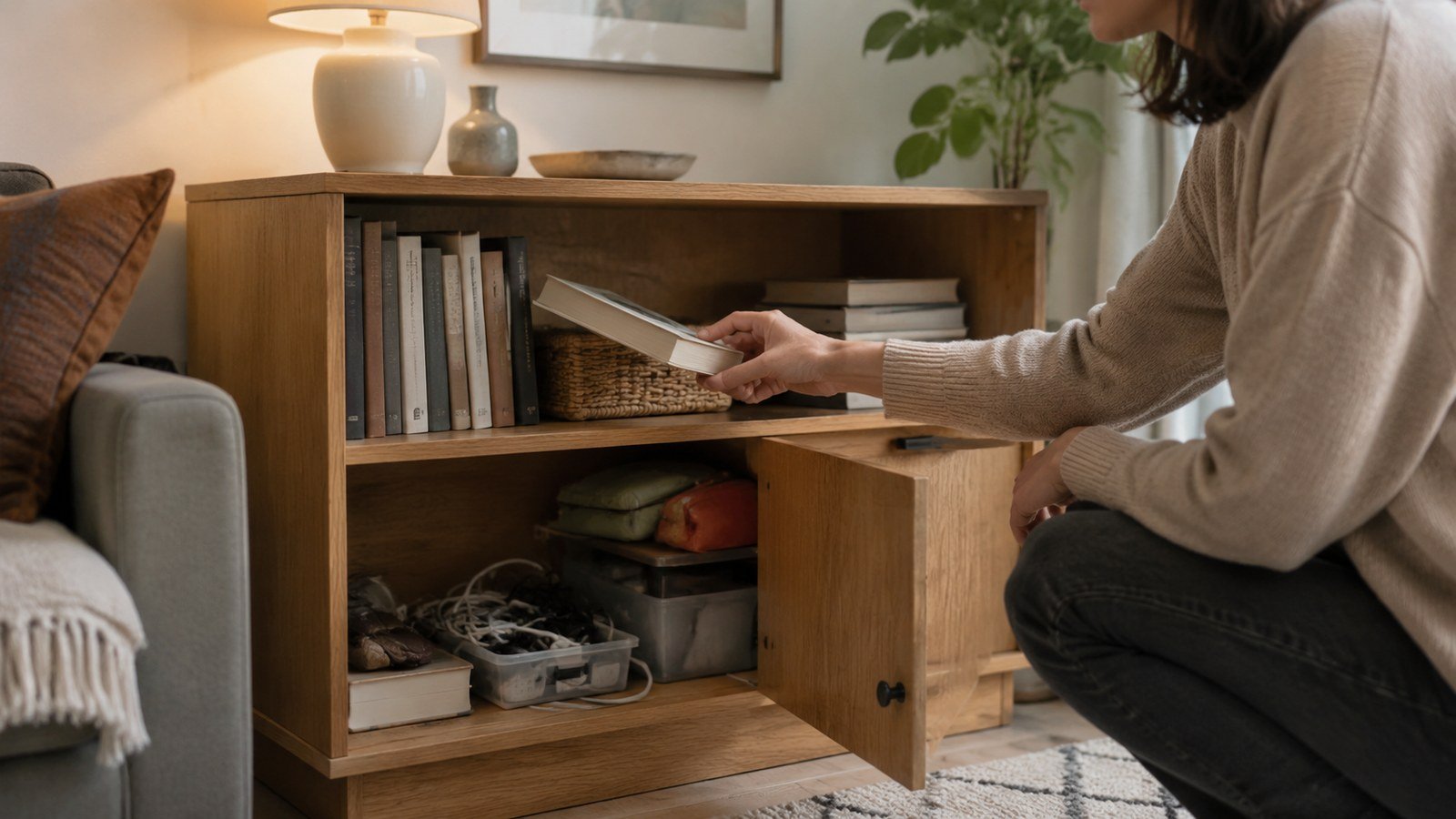
Open shelves can make an everyday item easy to find. They can also make a room feel busy before you have touched anything. Closed storage can create visual calm, but it can turn a needed supply into something you forget exists.
The useful question is not whether open or closed storage is better. It is which items earn visibility, which need protection, and which can stay findable with a partial cue. The Open-Storage Test uses four factors: use frequency, visual load, reset effort, and the consequence of forgetting.
Score the item, not the room’s style
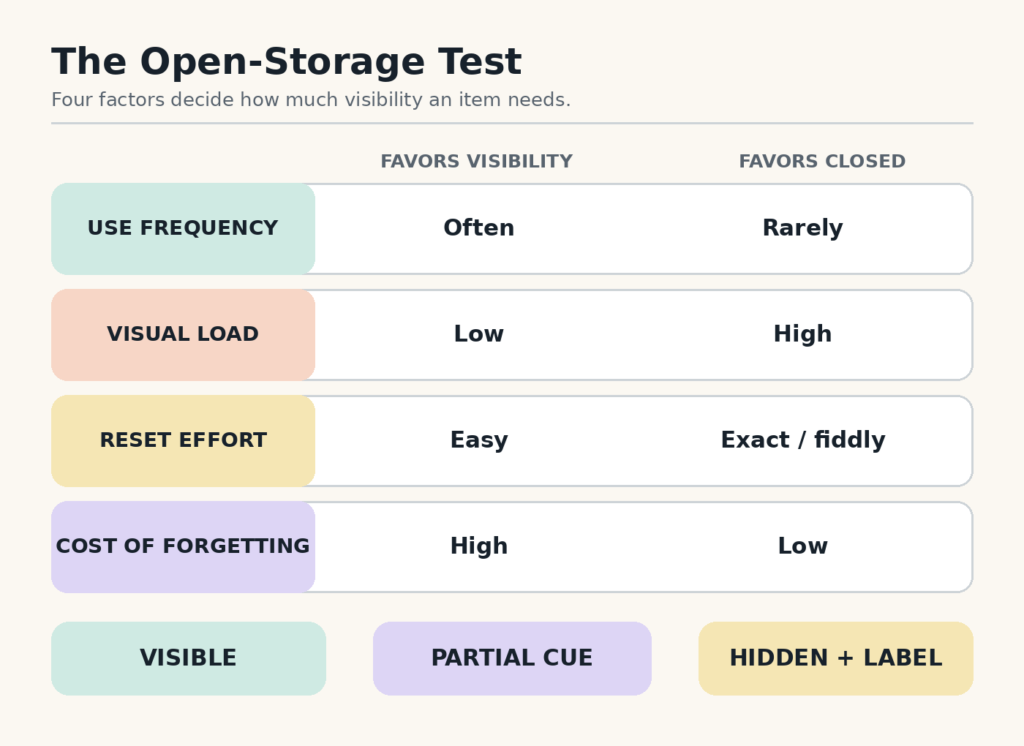
Take one category—daily skincare, pantry snacks, craft supplies, papers, or cleaning products—and consider each factor.
Use frequency
Daily and several-times-a-week items gain more from a short visible route. Rare items can usually tolerate a door, lid, label, or higher shelf. Frequency is about the current season of life, not the item’s theoretical usefulness.
Visual load
Some objects read as one calm unit; others create many small edges, colors, labels, and shapes. Five matching mugs may be easy to take in. Fifteen mixed packets, cables, and bottles can require more visual sorting even when they are arranged.
Laboratory research reported by Yale News found that visual crowding can make a target harder to identify and changes how information moves through the visual cortex. That study does not prove that open shelving causes stress or that every home should hide its belongings. It supports a narrower design point: when many competing objects must be visually separated, finding the target can require more work.
Reset effort
Open storage stays useful only if returning the item is easy. A deep open basket that must be sorted precisely is not low-friction merely because it has no lid. A closed drawer with one broad category may be easier to reset than a styled shelf with assigned positions.
Consequence of forgetting
Visibility matters more when forgetting creates waste, delay, or a missed obligation. Current forms, food that expires quickly, and supplies needed for a daily routine may need a visible cue. Important does not always mean exposed: medication and confidential papers may need safe closed storage plus a separate reminder.
Choose visible, partially visible, or hidden-and-labeled
Keep it visible when access and memory matter most
Use open storage when the item is frequent, visually manageable, easy to return, and safe to leave accessible. Examples may include a small dish for keys, the two pans used every day, a limited row of current shoes, or an open basket for clean towels.
Give visible items a boundary. An open shelf is not an unlimited category. Keep enough spare space to return the normal item without rebuilding the arrangement.
Use partial visibility when you need a cue without the full display
Partial visibility includes a low open bin, a wire basket, a clear-front container, a labeled opaque basket, or one sample item left visible while the supply sits behind it. This middle route works well when the category has many small pieces but still needs a recognition cue.
Avoid clear containers by default if the contents are visually dense. Transparency is useful only when seeing the exact stock level or item shape reduces more effort than the visible mixture creates.
Hide and label when protection or visual load matters most
Closed storage suits backups, occasional tools, paperwork, visually mixed supplies, and anything requiring protection from light, dust, moisture, children, or pets. Use an outside label based on the decision you will make—“printer refills” or “travel documents”—rather than a vague category such as “miscellaneous.”
If a hidden item is repeatedly forgotten, do not immediately expose the entire category. Add a cue at the point of action: a short list inside the cabinet door, a calendar reminder, a sample item, or a labeled front edge.
Run the test on common categories
- Everyday dishes: visible or behind an easy door if the set is small and used constantly; hide backups and special-occasion pieces.
- Pantry food: use visible fronts or shallow groups for current food; keep backstock labeled and avoid deep rows that hide expiry.
- Bathroom products: keep the current routine easy to reach; hide reserve stock and protect medication according to its storage requirements.
- Children’s materials: broad open categories can support independent return; rotate excess rather than displaying every option.
- Paper: keep the small active set visible in one bounded action place; archive or discard completed material.
- Hobby supplies: expose the current project or working kit; store the wider inventory in labeled closed groups.
Test one shelf for seven days
- Choose a shelf, counter section, or drawer that repeatedly feels difficult.
- Remove the contents and return only the items used in an ordinary week.
- Assign each category to visible, partially visible, or hidden-and-labeled.
- Leave at least one return space rather than filling the boundary perfectly.
- Notice searching, forgetting, and reset effort for seven days.
Change only the factor that failed. If you still forget the item, strengthen the cue. If the shelf feels noisy, reduce what is exposed. If objects remain beside the container, shorten the return motion. If the category overflows, divide current use from backup stock.
Let different people need different cues
One household member may remember a closed category easily while another needs to see it. Use shared public zones for the items everyone must locate, and allow more personal storage grammar in individual spaces. Large labels, open fronts, contrasting shelf edges, and comfortable reach can improve access without exposing every possession.
Begin with the item that is repeatedly lost, forgotten, or difficult to return. Decide how much visibility its real use requires, then give the rest of the visual field some room. The goal is not an open-storage home or a closed-storage home. It is a home where the next needed object can be found without every other object asking for attention at the same time.
Free GentleDone resource
Overwhelmed? Start with 10 minutes.
The GentleDone 10-Minute Reset gives you one deliberately small place to begin.