
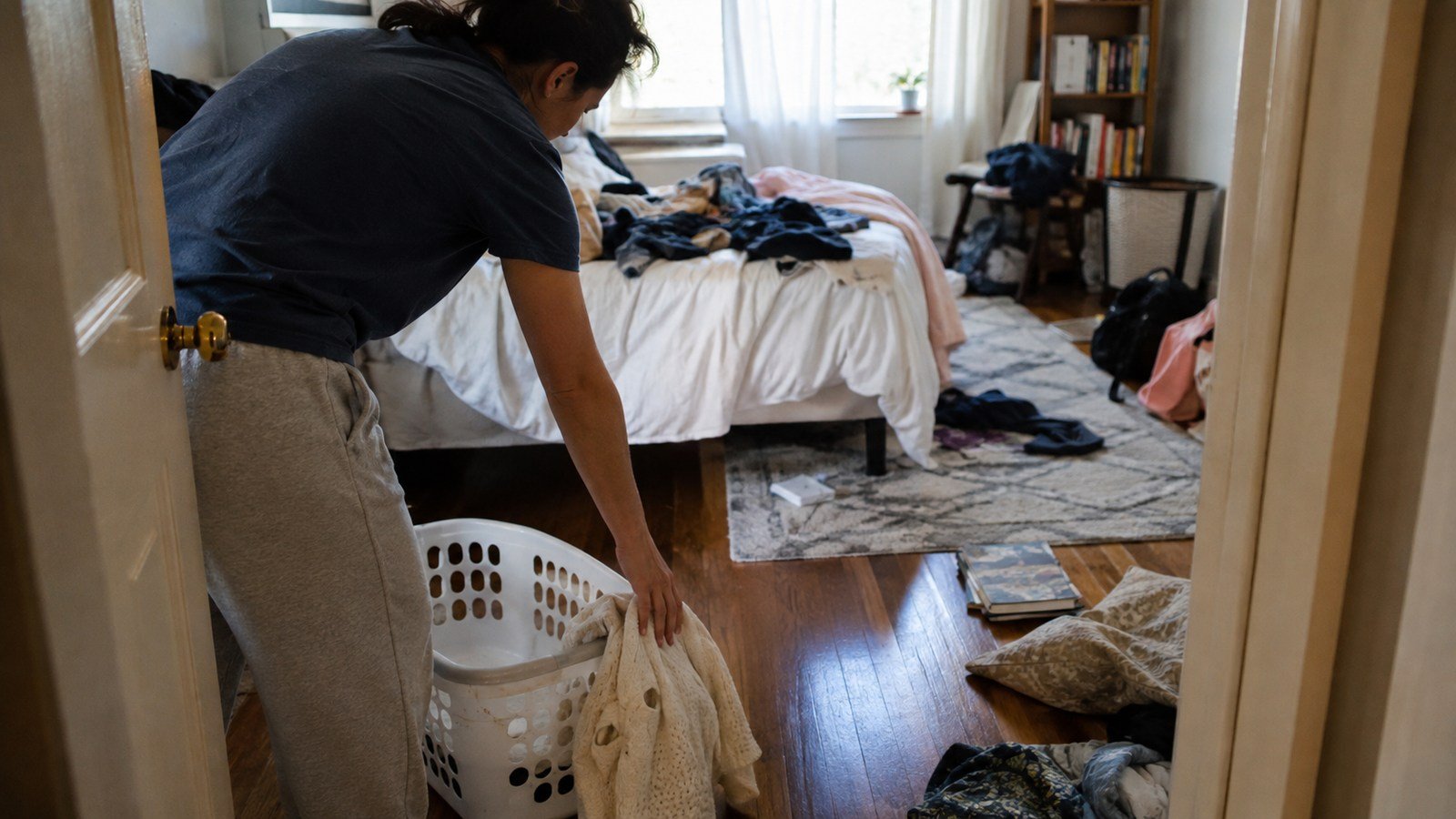
A very messy room can hide its own starting point. The floor is interrupted, every surface holds mixed objects, and each possible action seems to uncover five more. “Clean the room” is too large to direct the next movement.
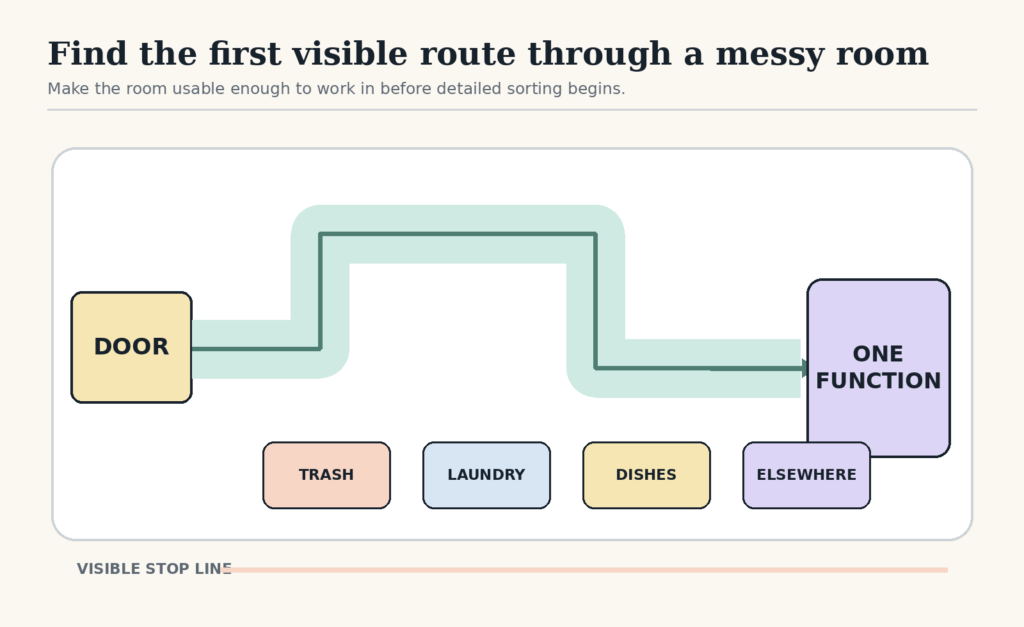
Start by making the room usable enough to work in. Create one safe path, remove the objects with obvious exits, restore one important function, and stop at a visible boundary. This is a first-pass room reset, not a promise to sort everything today.
Do a safety scan before touching the pile
Stand at the doorway and look for anything that changes the job: broken glass or sharps, bodily fluids, pests, unstable stacks, exposed wiring, strong chemical odors, extensive water damage, or substantial mold. Keep children and pets away from a work area that contains hazards.
Do not improvise around an unknown chemical or combine cleaning products. The CDC advises never mixing household bleach or disinfectants with other cleaners and recommends ventilation and following label directions. For visible mold or moisture damage, use the EPA’s mold cleanup guidance to judge whether the area is appropriate for a household cleanup or needs professional help.
If the room is unsafe to enter or the hazard is outside your ability, stop. The first useful action may be isolating the area and arranging appropriate help.
Create one working path
Choose the shortest route from the doorway to the room’s main function: the bed, desk, chair, closet, or window. Clear only that strip at first. Move each object to one of four temporary destinations:
- trash or recycling;
- laundry;
- dishes or food items leaving the room;
- one sturdy “belongs elsewhere” basket.
Do not make category piles on the floor. They consume the space you are trying to recover and create new decisions at every step. Use containers you can lift, and stop filling any bag before it becomes unsafe to carry.
Remove obvious exits before sorting
Take one pass for items that already have a clear destination. You do not need to decide where every possession belongs.
- Collect obvious trash and recycling.
- Move dishes and food out of the room.
- Put washable clothing and linens in the laundry container.
- Place items that clearly belong in another room into one travel basket.
Finish each exit when practical. Take trash to the bin, dishes to the kitchen, and laundry to its next real location. A full bag left in the doorway is not yet an exit.
If you cannot leave the room repeatedly, park the closed containers just outside the working path and move them at the end of the pass. Keep doorways, heating equipment, and walking routes clear.
Restore one function, not the whole room
Choose the function with today’s clearest consequence. It may be enough space to sleep, a chair to sit in, a desk area for tomorrow’s work, or a clear route to needed clothing.
Define the finish in observable terms:
- the bed can be used safely tonight;
- the desk has space for a laptop and one notebook;
- the chair and the floor in front of it are clear;
- the closet door opens and the daily clothing section is reachable.
Work only inside that boundary. Move undecided items into one review container rather than scattering them across another surface. Label the container with the room and a review date if it will not be handled today.
Clean the recovered area after the objects move
Once the path and functional area are clear, remove ordinary dust or debris using a method suitable for the surface. Read product labels, ventilate as directed, and keep incompatible products separate. Cleaning visible dirt generally comes before disinfecting; disinfecting every household surface is not automatically necessary.
Do not spray cleaner into a dense pile or onto unknown materials. Object removal and surface cleaning are separate passes. This keeps wet products away from papers, electronics, textiles, and items that still need decisions.
Choose a visible stop line
Stop when the planned path is open, the chosen function works, and the obvious exits have moved to their next location. The room may still look unfinished. That does not erase the recovered function.
Leave a clean handoff for the next pass:
- one closed review container, not several loose piles;
- one written next zone, such as “left side of desk”;
- supplies returned to a safe parking place;
- the doorway and working path still clear.
A stop line prevents the first reset from expanding into an exhausting whole-room sort.
Use a second pass only after the first route holds
On the next session, choose one adjoining zone. The Floor-First Reset can help if the recovered path needs to expand into functional floor areas. If surfaces refill because objects have no practical return route, use Low-Friction Home Organization before buying containers.
If the same room repeatedly becomes unusable, look for the recurring inflow: clean laundry without an easy home, packages without an exit, project materials that stay open, or too many categories sharing one surface. Repair one inflow between resets.
Restart with the smallest visible route
If you stop after five minutes, preserve the path you opened and remove one complete exit. On the next return, begin at the edge of the recovered space rather than surveying the whole room again.
The first question is not “Where should everything go?” It is “What small route would make this room usable enough for the next necessary thing?” Clear that route, restore that function, and let the visible boundary hold the rest for another pass.
Free GentleDone resource
Overwhelmed? Start with 10 minutes.
The GentleDone 10-Minute Reset gives you one deliberately small place to begin.