

When a room feels unusable, the floor often carries the problem. Bags narrow the doorway, laundry covers the route to the bed, and objects gather around the places where daily tasks should happen. Starting with shelves or drawers may make a tidy corner, but it does not restore movement.
A floor-first reset recovers the walking path and the floor zones required for the room’s main function. It does not mean every floor object must be sorted today. It means the room becomes enterable, movable, and usable before detailed organizing begins.
Define the floor you actually need
Do not begin with “clear the entire floor.” Mark two kinds of space:
- Path: the route from the doorway to the room’s main destination.
- Functional pads: the floor needed to stand, sit, open a door or drawer, change clothes, or use the bed or desk.
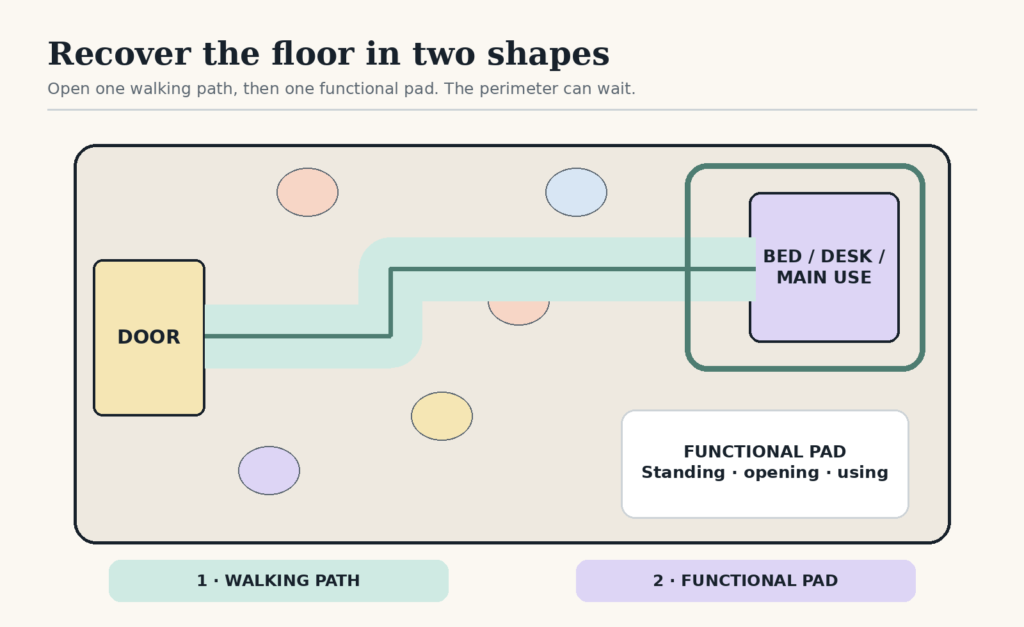
In a bedroom, that may be a path to the bed, standing room beside it, and clearance for the closet door. In an office, it may be a route to the chair plus enough floor for the chair to move. The remaining perimeter can wait.
Set four destinations before lifting anything
Place containers at the edge of the room for:
- trash and recycling;
- laundry and washable linens;
- items that leave the room;
- items that stay but do not yet have an easy home.
Keep the fourth container small. It is a temporary review queue, not permission to move the whole floor into a larger hidden pile. If it fills, stop adding to it and restore the planned floor route with the other three exits first.
Use safe lifting habits and containers you can carry. If you see sharps, broken glass, unstable furniture, bodily fluids, pests, unknown chemicals, or significant mold or water damage, pause the ordinary reset and handle the hazard appropriately.
Open a strip from the doorway inward
Work from the visible edge of the path. Pick up only what is directly in front of the next step. This creates a clear direction and prevents you from stepping over objects to reach a more interesting pile.
For each object, make the smallest available routing decision:
- obvious exit goes to its exit container;
- known home goes there only if it is close and does not start another project;
- unclear home goes to the bounded review container;
- active project pieces stay together in one tray or box.
Do not fold laundry, read papers, test cables, or begin sentimental decisions while opening the path. Those are later workflows. The current job is floor recovery.
Expand into one functional pad
Once the path reaches the room’s main destination, clear the floor immediately around it. Choose the pad with the most practical value today.
Examples include:
- enough space to place both feet beside the bed;
- clearance for a chair to pull out and turn;
- room for a closet or cabinet door to open fully;
- a clear rectangle for a child’s play or dressing area;
- access to a radiator, vent, or other area that should not be blocked.
Let furniture edges define the boundary. A visible rectangle is easier to finish than an instruction such as “do more of the room.”
Remove the exit containers before improving the edges
Take trash, dishes, laundry, and out-of-room items to their next real locations. If an exit cannot be completed, place the closed container outside the recovered path and write its next action.
Only then decide whether to continue. The temptation is to use the new floor space as a staging area for the rest of the room. Avoid that. Recovered floor is the result, not a new sorting surface.
Clean only the exposed floor
Sweep, vacuum, or clean the recovered route using a method appropriate for the flooring. Do not move heavy furniture or soak an area simply to make the reset feel complete. If the floor is damaged, wet, loose, or otherwise unsafe, protect the route and address that condition separately.
Cleaning the exposed strip gives the boundary a visible finish. It also makes it easier to notice whether loose objects begin returning to the path.
Stop when movement and function return
A floor-first reset is complete when:
- the doorway opens as needed;
- the planned walking path is clear;
- one functional pad can be used;
- exit containers have moved forward;
- the recovered floor is not being used as a new staging area.
The perimeter, shelves, and review container can remain unfinished. Write one next zone—“floor beside dresser” or “review basket”—and leave the route intact.
Prevent the path from becoming a landing zone again
Watch what returns during the next few days. If clean clothes land on the floor, the laundry return may require an easier model such as open bins and baskets for a no-fold system. If bags and keys enter the room without a home, move their landing point closer to the doorway. If donations wait on the path, use a bounded donation exit system.
Protect the route with a simple rule: nothing is parked in the walking strip. The rule is specific enough to share and small enough to notice.
Restart from the last clear edge
If the room slips again, do not begin with a full-room assessment. Stand at the doorway, locate the last clear edge, and advance it by one object or one foot of space. Complete one exit before opening a second container.
If no safe path is visible at all, start with How to Clean a Room When You Cannot See a Starting Point. The floor-first method begins as soon as one safe strip can be defined.
The room does not need to look finished to become usable. Recover the route, protect one working pad, and let movement return before asking the room to hold a more detailed system.
Free GentleDone resource
Overwhelmed? Start with 10 minutes.
The GentleDone 10-Minute Reset gives you one deliberately small place to begin.