
A no-fold laundry system can remove a step, but it still needs a reliable final home. If clean clothing is dropped into one deep hamper, the folding is gone and the searching begins. The best open bins divide clothing broadly enough to find, return, and refill without requiring neat stacks.
This guide compares five currently available open or open-front containers by access, dimensions, material, and likely fit. None was tested hands-on for this article. Product links are direct retailer links and are not affiliate links at publication. Prices and availability can change, so confirm the current listing and your shelf measurements before buying.
Measure the route before choosing the bin
Start with the place where clean clothing will actually be put away. Measure:
- the usable width, depth, and height of each shelf opening;
- the clearance needed to lift or pull a container;
- the comfortable reach of the person using it;
- the amount of each clothing category between normal laundry days;
- the path from dryer or drying rack to the storage area.
Do not use the cabinet’s outside dimensions. Hinges, shelf supports, baseboards, and trim can reduce the opening. Leave finger room around a bin and space above it for dropping clothing in. A perfect wall-to-wall fit can make every return harder.
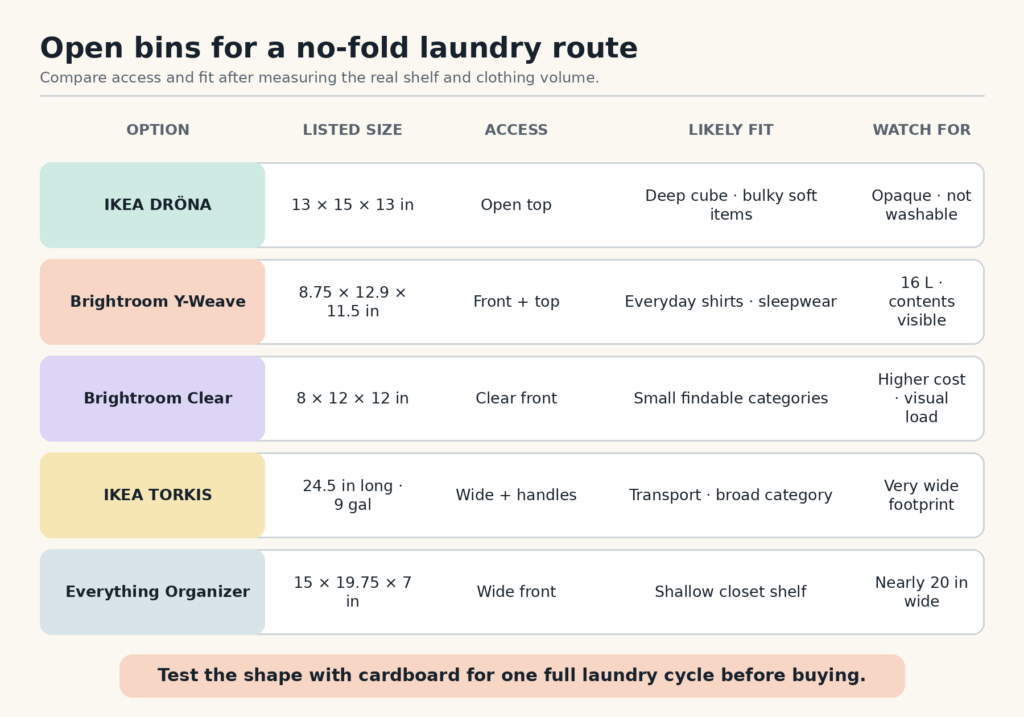
Quick comparison
| Option | Listed size | Access style | Best likely fit | Main trade-off |
|---|---|---|---|---|
| IKEA DRÖNA | 13 × 15 × 13 in | Open top, fabric sides | Deep cube shelf; bulky soft categories | Contents are not visible; listing says do not wash |
| Brightroom Y-Weave Easy Access | 8.75 × 12.9 × 11.5 in | Open front and top | Everyday shirts, sleepwear, or activewear on a cube shelf | Smaller 16 L capacity; open pattern exposes contents |
| Brightroom Clear Open-Front | 8 × 12 × 12 in | Clear, stackable open front | Smaller categories that need visibility | Higher price per bin; transparent contents add visual load |
| IKEA TORKIS | 24.5 × 10.75 in; 9 gal | Wide flexible basket with handles | Transport or broad floor-level categories | Footprint may be too wide for shelving |
| Everything Organizer Open-Front | 15 × 19.75 × 7 in | Extra-wide open front; stackable | Shallow closet shelves and wide categories | Largest listed price and almost 20-inch width |
IKEA DRÖNA: deep cube storage for soft, bulky categories
The IKEA DRÖNA box is listed at 13 inches wide, 15 inches deep, and 13 inches high for $4.99 when checked on August 14, 2026. IKEA says it fits KALLAX and shelves at least 13.75 inches deep. The fabric is mostly recycled polyester, the box has integrated handles, and the care instructions say to use a vacuum cleaner or lint roller rather than wash it.
Best likely fit: sweaters, pajamas, lounge clothing, or another soft category that can fill a deep cube without needing exact visibility.
Trade-off: the high sides and opaque fabric hide what is below the top layer. This is a better category bin than a mixed-clothing bin. It also needs enough shelf depth; the 15-inch box may project from shallower furniture even if the width fits.
Brightroom Y-Weave Easy Access: low-cost front access for a 13-inch cube
Target lists the Brightroom Y-Weave Easy Access Storage Bin as a 16-liter polypropylene bin measuring 8.75 inches high, 12.9 inches wide, and 11.5 inches deep. The listing describes it as compatible with a 13-inch cube and nestable when empty. It was shown at $5.40 on sale, with a regular price of $9, when checked on August 14, 2026.
Best likely fit: shirts, leggings, sleepwear, or activewear that you want to reach through the front without pulling the whole bin out.
Trade-off: the lower front improves access but reduces containment. A tightly packed category may spill forward. The woven openings also leave clothing visible, which can help recognition or add visual busyness depending on the room.
Brightroom Clear Open-Front: strong visibility for smaller categories
The Brightroom 12-by-12-by-8-inch clear open-front bin is listed at $13 and 1,152 cubic inches. Target describes the PET container as stackable with an open front.
Best likely fit: socks, underwear, swimwear, workout accessories, or another small category where seeing the remaining stock saves searching.
Trade-off: the transparent front displays every color and edge. If the storage sits in a visually active bedroom, an opaque option may feel calmer. Check the loaded stack carefully; “stackable” does not mean every furniture surface or tall stack will be stable.
IKEA TORKIS: a flexible basket for carrying and broad categories
The IKEA TORKIS flexible laundry basket is listed at $9.99, with a 9-gallon capacity, 24.5-inch length, and 10.75-inch height. It is made from polyethylene and has two handles.
Best likely fit: carrying clean clothing from the laundry area, collecting one large category, or serving as a wide floor-level bin where a tall rigid hamper would be difficult to reach into.
Trade-off: at more than two feet long, it needs a wide footprint and is unlikely to fit an ordinary cube shelf. It may work better as the transport stage of the no-fold route than as the final home for several separate categories.
Everything Organizer Open-Front: extra-wide access on a shallow shelf
The Container Store lists its Everything Organizer Open-Front Bin at 15 inches deep, 19.75 inches wide, and 7 inches high. The modular stackable bin was displayed at $20.99 on sale, with a regular price of $29.99, when checked on August 14, 2026.
Best likely fit: a wide closet shelf holding jeans, sweatshirts, towels, or another broad category that benefits from a shallow front opening.
Trade-off: it is nearly 20 inches wide and the most expensive option in this comparison. Confirm that the shelf can support the footprint and that stacking will not place the upper opening beyond comfortable reach.
Match the container to the clothing category
- Socks and underwear: shallow, smaller bins prevent pieces from disappearing under a deep pile.
- T-shirts and sleepwear: medium open-front bins allow a hand to reach the current layer without removing the container.
- Jeans and sweatshirts: wider or stronger containers support bulk; avoid overfilling a flexible fabric cube until it bows.
- Seasonal clothing: closed or lidded storage may protect better than an everyday open bin, especially in dusty or damp areas.
- Children’s clothing: low, broad categories can support independent returns; confirm that furniture and stacked containers are stable and appropriately anchored.
A person does not need a bin for every conventional clothing category. Start with the categories that currently become piles. Two broad homes—“everyday tops” and “everything worn below the waist”—may be more sustainable than eight precise divisions.
Test the shape with cardboard before buying
Mark the listed width and depth on the shelf with paper or painter’s tape. Use a cardboard box, shopping bag, or existing basket at roughly the same height. Fill it with the real category for one laundry cycle.
Notice whether you can drop clothing in with one hand, whether the lowest layer is findable, whether the bin must be pulled out, and whether a full container becomes too heavy. This trial can reveal that you need two shallow bins instead of one deep one—or that an open shelf with simple dividers is enough.
When an open bin is the wrong tool
Choose another route if the area is damp, dusty, exposed to pests, or accessible to pets that disturb clothing. Closed drawers may be better when visual calm matters and the return motion is still easy. Hanging may remain the lowest-friction option for garments that crease heavily or are used as complete outfits.
A no-fold system is not a promise never to fold anything. Fold or hang the few garments that benefit, and remove folding from the categories where it produces a recurring bottleneck. Use the full laundry system without folding everything to connect sorting, washing, drying, and the final return route.
Buy only after the shelf, category, access style, and capacity have survived one real laundry cycle. The best bin is not the one that looks most organized while empty. It is the one you can refill on an ordinary day without turning clean clothing into another unfinished project.
Free GentleDone resource
Overwhelmed? Start with 10 minutes.
The GentleDone 10-Minute Reset gives you one deliberately small place to begin.