

Fifteen minutes is long enough to change the state of meaningful work and short enough to waste while deciding what to do. The difference is not motivation. It is whether the task has been cut into a closed slice before the clock starts.
A closed slice produces visible evidence and leaves a clean next entrance. It is not “work on report for 15 minutes.” It is “read the three customer quotes, label the repeated problem, and leave the label at the top of the draft.”
Build the slice with four boundaries
- Object: the one document, surface, message, or decision you will touch.
- Action: a visible verb such as compare, mark, draft, rename, test, or send.
- Evidence: what will exist or be different when the slice ends.
- Exit: what you will record if time ends first.
Write those boundaries in one sentence: “In the budget sheet, compare the three subscription rows, mark any increase over $20, and leave the next unchecked row highlighted.”
Choose work that can close locally
A large project can contain many locally complete slices. The whole project stays open, but the current movement closes cleanly.
| Large work | 15-minute closed slice | Evidence |
|---|---|---|
| Write a presentation | Draft the claim and evidence for slide three | One usable slide outline |
| Prepare taxes | Download and rename the four bank statements | Four findable files |
| Clean a room | Clear the path from door to bed | A walkable route |
| Plan a project | Turn one vague phase into its next deliverable | One named output and owner |
| Handle email | Find messages with deadlines in the next two days | A short urgent set |
If the first action still feels abstract, use the guide to making a task enterable. If the project itself is still a noun, first name the smallest visible result that would move it forward.
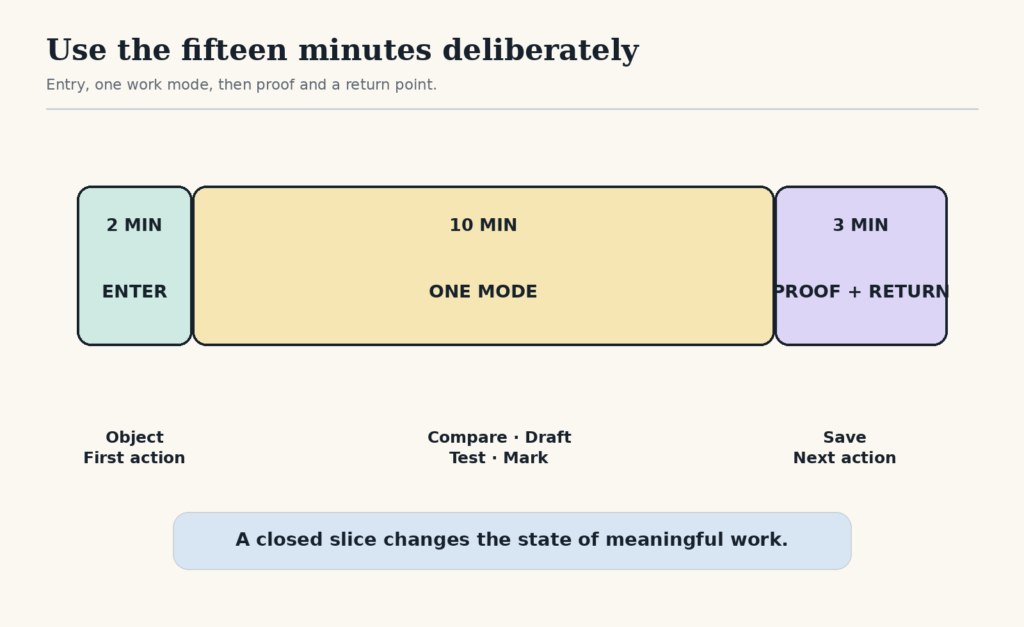
Spend no more than two minutes entering
A short window cannot support a long setup ritual. Keep a default entry route:
- open the named object;
- hide unrelated windows;
- write the finish evidence;
- start with the first physical or digital change.
If the needed file, password, tool, or instruction cannot be found in two minutes, change the slice. The new slice is “locate and stage the missing input.” That is legitimate progress because it changes the next entry.
Use the middle ten minutes for one mode
Do not mix gathering, deciding, drafting, formatting, and sending unless the slice truly requires it. Choose one mode. You might gather five facts, compare three options, draft one paragraph, test one workflow, or clear one bounded physical area.
Research on sustained attention has found that brief, infrequent breaks can reduce vigilance decline in a particular laboratory task. This is not proof that a 15-minute schedule is ideal for everyone or every job. It is a useful reminder that attention need not be treated as one continuous reservoir. Read the original brief-break study.
Reserve the last three minutes for proof and return
At the end, do not ask only whether the project is finished. Ask:
- What changed?
- Where is the output?
- What is the next visible action?
- Is anything now waiting on a person or event?
Save, label, send, or place the output where the next session will find it. If you stopped mid-sentence or mid-calculation, leave a re-entry note. Studies of interrupted work have examined how thoughts about an unfinished task can persist after switching and how a brief ready-to-resume plan may help. The evidence does not erase the cost of interruption; it supports leaving a deliberate handoff. See the attention-residue study and the ready-to-resume study.
Use a second slice only after a real stop
When the timer ends, close the slice. Stand up, drink water, look away from the screen, or take another brief transition that fits the setting. Then choose deliberately whether to begin another slice. Do not let “just one more” remove the boundary that made the first window safe to enter.
Example: returning to a delayed report
Priya has avoided a monthly report because “finish report” feels larger than the gaps in her day. Her first slice becomes: open the reporting sheet, check the date range, and list the three missing numbers. She finishes with a list.
Later, the second slice becomes: locate the first missing number and enter its source in the comment. She does not promise to complete all three. After 12 minutes, the number is entered and the next source is named. Two short windows have moved the report from vague avoidance to a visible sequence.
When fifteen minutes is the wrong container
Do not force safety-critical work, a sensitive conversation, a legal review, or a task with a costly setup into an arbitrary timer. Some work requires continuity, supervision, or a complete procedure. Use the short window to prepare the environment, identify the correct owner, or schedule the protected block instead.
A 15-minute window is useful when it creates a trustworthy beginning and a visible handoff. The promise is not that every task fits. The promise is that a small, closed movement can still count.
Free GentleDone resource
Overwhelmed? Start with 10 minutes.
The GentleDone 10-Minute Reset gives you one deliberately small place to begin.