

An undated planner removes the penalty of a blank dated page. It does not automatically make planning flexible. Some undated layouts still expect a full schedule, a long task list, several trackers, and an evening review every day.
For variable-capacity days, evaluate the pressure created by the page: how much must be filled, how easily a missed day can restart, whether a minimum day has somewhere honest to live, and whether the book fits where planning actually happens.
Start with five fit questions
- Page pressure: Does an empty section feel like useful space or unfinished work?
- Minimum-day space: Can one appointment and one protected outcome fit without pretending the day is full?
- Re-entry: Can you turn to the next page after a gap without calculation or catch-up?
- Planning horizon: Do you need one day, a week, or a month visible while making decisions?
- Physical fit: Will the size, weight, binding, and duration work at your desk or in your bag?
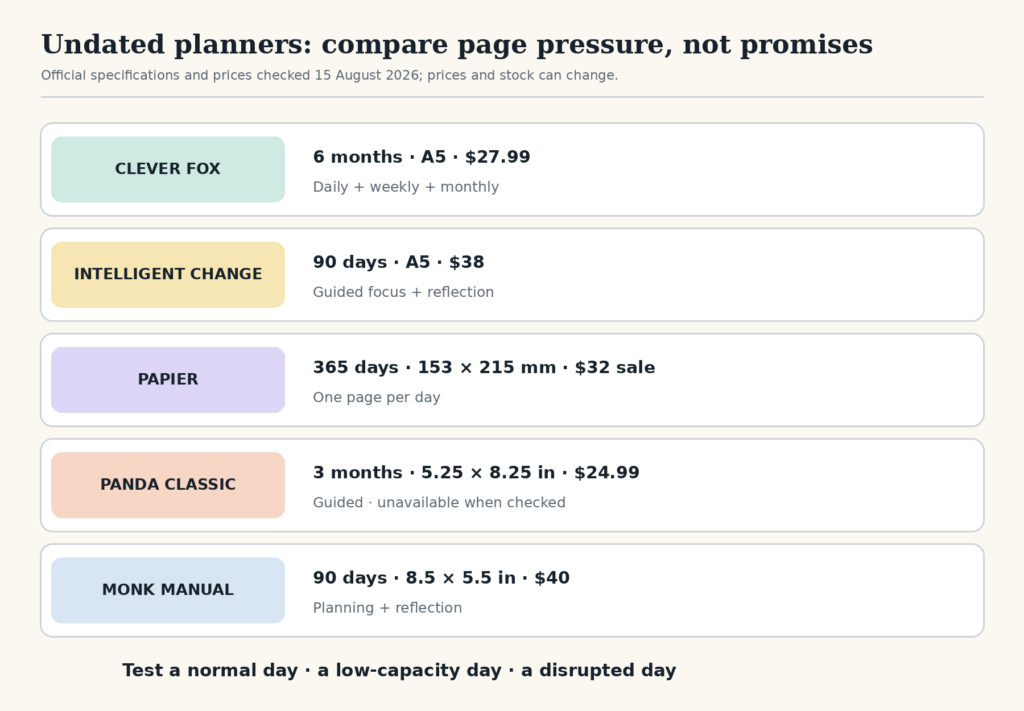
Five current planners, compared by use case
Clever Fox Daily Planner, 2nd Edition
Best fit: someone who wants daily, weekly, and monthly structure in one six-month A5 book.
The official listing describes an undated six-month planner with daily, weekly, and monthly pages, an hourly layout, 120gsm paper, three ribbon bookmarks, a pocket, pen loop, stickers, and an A5 size of 5.8 by 8.3 inches. It was listed at $27.99 when checked. The broad structure may suit someone who wants goals and schedule on the page; it may feel too directive if trackers and prompts become visual debt. See the official Clever Fox listing.
Intelligent Change Productivity Planner
Best fit: someone who wants a bounded 90-day system with prioritization, scheduling, reflection, and a focus-session method.
The official page lists a three-month, 256-page, undated A5 planner measuring about 5.7 by 8.26 inches. It includes daily two-page layouts, 6:00 a.m.–9:30 p.m. scheduling, monthly calendars, habit trackers, weekly planning and review, and a built-in Focus Time framework. It was $38 when checked. The structured prompts can provide an entrance; they can also create pressure if you prefer a nearly blank day. See the official Productivity Planner page.
Papier Undated Daily Planner
Best fit: someone who wants one page per day and a full year of undated daily pages with lighter built-in methodology.
The New Beginnings version lists 365 undated daily pages, 12 undated monthly views, gridded notes pages, dimensions of 153 by 215 mm, and 100gsm inner paper. It was shown at $32 sale price, $40 regular, when checked. A daily page offers room and clean re-entry, but a 400-side hardback book is a larger physical commitment than a 90-day planner. See the official Papier listing.
Panda Planner Classic
Best fit: someone who wants a compact three-month planner divided into daily planning sections and does not mind guided prompts.
The official listing identifies a 5.25 by 8.25-inch undated hardcover and a three-month format. It was listed at $24.99 but marked unavailable when checked. The compact horizon can reduce commitment after a long gap; the guided positive-psychology framing may not fit readers who want a neutral planning surface. See the official Panda Planner page.
Monk Manual 90-Day Planner
Best fit: someone who wants daily, weekly, and monthly planning combined with substantial reflection and values-oriented prompts.
The manufacturer lists a 90-day planner measuring 8.5 by 5.5 inches, with one full-page spread for every day, week, and month, 260 color pages, 100gsm acid-free paper, and a lay-flat binding. A single planner was $40 when checked. Its reflective method is a core part of the product, so choose it for that experience rather than as a neutral task pad. See the official Monk Manual page.
Use the page-pressure test before buying
Print or sketch a rectangle the size of the planner. Copy the main daily sections from the official preview using generic labels—schedule, priorities, notes, reflection—and plan three real days:
- a normal day;
- a low-capacity day with one fixed commitment;
- a disrupted day that begins after lunch.
Notice whether the layout helps you choose or makes empty areas feel like failure. Do not buy a six- or twelve-month object to discover that the daily page argues with your actual days.
Choose by the constraint that matters most
| If you need… | Start by examining… | Watch for… |
|---|---|---|
| A shorter commitment | Intelligent Change, Panda, or Monk Manual | Guided prompts that may add page pressure |
| A full undated year | Papier | Book size and the expectation of one page per day |
| Goals plus daily/weekly/monthly structure | Clever Fox | Sections you may feel obliged to complete |
| Reflection as part of planning | Monk Manual or Intelligent Change | Whether the prompt language fits you |
| A compact carry size | Compare listed dimensions and weight | Page space lost to smaller format |
A planner cannot repair an oversized day
If every layout overfills, the problem may be selection rather than paper. Use the variable-capacity planning system to define Minimum, Normal, and High-capacity lanes, or start with the Free Capacity Day Planner before buying a bound book.
The best undated planner is not the one with the most sections. It is the one you can leave, reopen, and use honestly on the kind of day you actually have.
Free GentleDone resource
Overwhelmed? Start with 10 minutes.
The GentleDone 10-Minute Reset gives you one deliberately small place to begin.