

When a routine stops fitting, the tempting repair is a complete redesign: new time, new order, new app, new supplies, and a fresh tracking sheet. The first day feels organized. The next day has no familiar entrance.
Change the routine as a short controlled trial instead. Preserve one recognizable cue, change the component most likely to be causing friction, and watch a few real attempts before deciding what to do next.
Map the routine before deciding what is broken
A routine is more than its list of actions. Write its current components in one line:
Cue → first action → order → tools and place → duration → stop
An evening reset might read: last dinner plate reaches sink → put food away → load dishes, wipe counter, prepare coffee → kitchen supplies in lower cabinet → about 12 minutes → one clear preparation area.
Now describe what actually happens. Do you miss the cue? Notice it and resist the first action? Leave to find a tool? Get trapped in one long step? Finish, but at too high a cost? The observed failure points to a component. A feeling that “the routine is not working” does not yet tell you what to change.
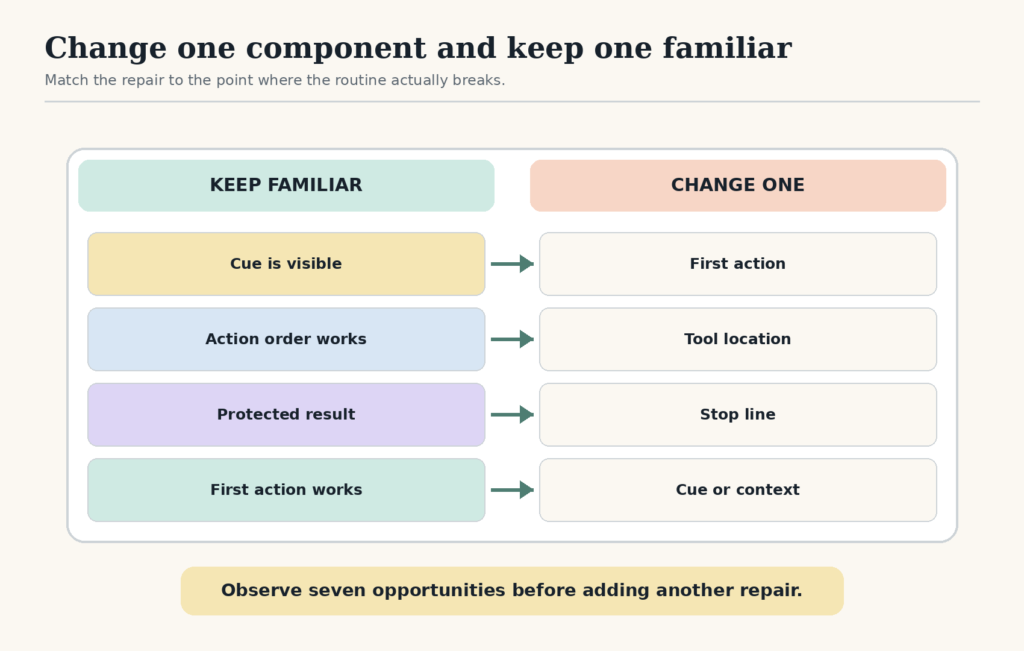
Preserve the cue when it is still visible
If you reliably notice the cue, keep it during the first trial. Familiar context can help prompt repeated behavior. Research on university students changing environments found that shifts in performance context were associated with changes in habit expression; the study concerns a specific population and transition, but it illustrates why replacing several contextual signals at once can make a known action harder to retrieve. See the original context-change study.
Keeping a cue is not superstition. It is a diagnostic control. If the cue remains and the changed action becomes easier, you have useful information.
Change the component closest to the observed friction
| Observed problem | Keep | Change first |
|---|---|---|
| You remember after the useful moment | Desired result | Cue |
| You notice the cue but avoid starting | Cue | First action or routine size |
| You leave midway to gather supplies | Cue and action order | Tool location |
| One step consistently creates a delay | Cue and other steps | Order or that step |
| You finish, but it consumes the whole evening | Protected result | Stop line or frequency |
Do not change the cue because the action is too large. Do not buy a new organizer because the cue is invisible. Match the repair to the evidence you have.
Run a seven-opportunity trial
Seven opportunities are enough to expose several ordinary contexts without pretending to be a scientific test. If the routine happens once a week, this may take seven weeks. If it happens daily, it may take a little more than one calendar week because missed cues are part of the information.
- Write the component you will keep.
- Write the one component you will change.
- Define the first action and stop line.
- For each opportunity, mark: cue noticed, routine started, useful result protected.
- Do not add another repair before the trial ends unless the current design is unsafe.
- After seven opportunities, keep, revert, or run one new change.
The free Routine Restart Worksheet includes space for the cue audit and seven-day re-entry record.
See three one-change repairs
The first action is too large
Jon notices “after I put my dinner plate in the sink” every night, but “clean the kitchen” feels like an open-ended project. He keeps the plate cue and changes the first action to “put refrigerated food away.” His stop line for limited days is one clear preparation square. The cue was not the problem; the routine lacked a reachable entrance.
The tools break the sequence
Priya begins a paper-planning routine after breakfast but walks upstairs to find a pen and then gets pulled into another task. She keeps the breakfast cue, notebook, and three-line plan. The only change is parking a working pen inside the notebook. If the routine starts more often, she has learned more than a new planner purchase would have shown.
The cue belongs to the old schedule
Alex used to prepare tomorrow’s bag after arriving home from the office. On remote days, that arrival never happens. The bag contents and stop line still work, so Alex creates a home-day cue: after the work laptop goes into its drawer, check tomorrow’s location and place the needed bag by the exit. In this case the cue—not the routine size—needed the change.
Know when preserving the cue is the wrong choice
Replace the cue when it is tied to a context that no longer exists, occurs after the consequence you are trying to prevent, depends on another person’s unpredictable behavior, or is so frequent that it blends into the day.
If the old cue carries strong distress, conflict, or safety concerns, do not preserve it merely for continuity. Choose a safer context and seek appropriate professional support when the routine relates to health, trauma, addiction, or another issue outside ordinary organization.
When you do change the cue, keep another component stable: the first action, the tool location, the wording, or the stop line. The event-based routine guide can help you select the replacement.
Make the decision from three signals
After the trial, ask:
- Was the cue visible? If not, repair the cue or context.
- Did the routine start? If not, repair the first action, size, or tools.
- Was the useful result protected? If not, repair the action or stop line.
A successful change does not have to make the routine pleasant. It should make the entrance clearer and the result more dependable at a reasonable cost. Keep the working version long enough to learn from ordinary days before improving it again.
Free GentleDone resource
Overwhelmed? Start with 10 minutes.
The GentleDone 10-Minute Reset gives you one deliberately small place to begin.