

“Do this at 7:00” sounds precise, but the routine has already failed when 7:00 belongs to school drop-off one day, a late wake-up the next, and a train platform on Thursday. The clock is still accurate. It just is not describing a stable entrance.
An event-based routine starts after something that already happens: after the kettle switches off, after the last lunch dish reaches the sink, or after you close the work laptop. The event does not make the action effortless. It makes the starting moment easier to recognize across days that do not run on one timetable.
Choose an anchor event you do not have to create
The strongest first candidate is an event that already occurs on most relevant days and sits close to the action. “After I wake up” may be too broad. “After my feet touch the bedroom floor” is observable, but it may still be a poor cue if you immediately need the bathroom or must help someone else.
List three events that reliably happen near the routine. Then test each one against four questions:
- Can I tell exactly when it has happened?
- Does it happen on the days I need this routine?
- Am I usually in the right place or moving toward it?
- Is there enough room after it for at least the minimum version?
If an event fails two questions, it is probably a hopeful association rather than a usable anchor.
Write the handoff as one visible sentence
Use this structure:
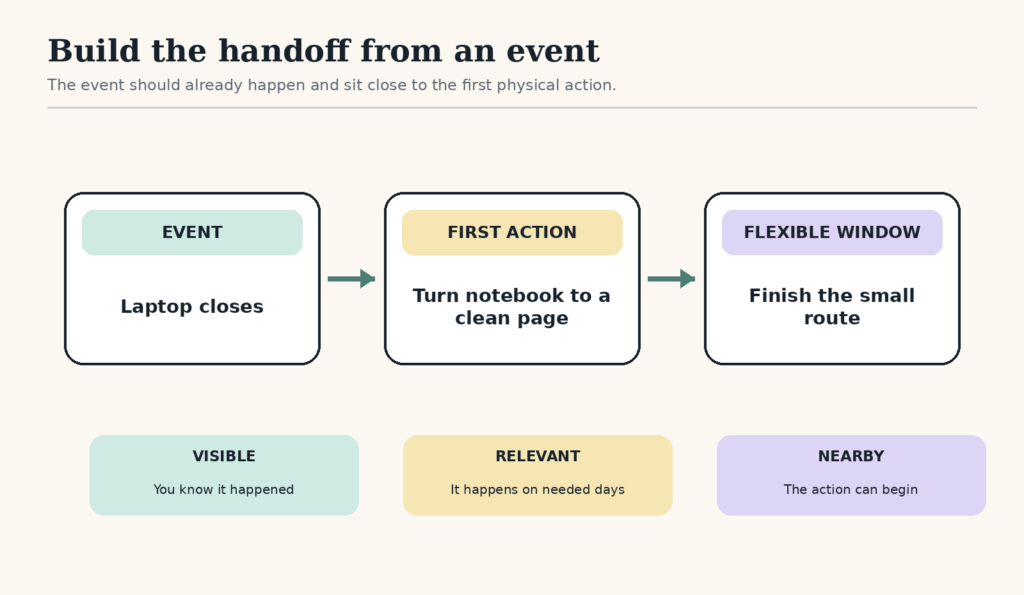
After [observable event], I will [first physical action].
“After dinner, I will tidy” leaves both halves vague. Dinner may end at different moments for different people, and “tidy” contains several decisions. “After I place the last dinner plate by the sink, I will put food that needs refrigeration away” gives the routine a visible handoff.
This is a form of implementation intention: an if-then plan connecting a situation to a response. The National Cancer Institute summarizes implementation-intention research and the proposed cue-response mechanism. It is a planning tool, not a promise that the chosen behavior will happen every time.
Put the routine after the event, not somewhere near it
A weak event cue often has a hidden gap. “I will stretch sometime after lunch” allows email, dishes, errands, and conversations to fill the space. The cue becomes a loose reminder rather than a handoff.
Reduce the gap by naming the first motion. After the lunch container closes, place both feet on the floor and stand. After the laptop closes, turn the notebook to a clean page. After the washing machine chimes, carry the empty basket to the machine.
The full routine can happen inside a flexible window. The first action should be close to the event.
Use a window when immediate action is unrealistic
Some anchors happen in the right sequence but not in a usable location. Leaving work may cue a home routine, but a commute sits between them. Keep the event and add a bounded window:
After I enter my home and put my bag down, I will begin the two-minute arrival reset before I sit.
The entry event is more useful than “after work” because it occurs where the action can begin. If the commute varies, the routine travels with arrival rather than with a fixed time.
A window should explain a real transition, not give the action the entire day. “Within ten minutes of putting my bag down” is testable. “Later that evening” is easy to renegotiate until bedtime.
Separate weekday, weekend, and location cues when needed
One cue does not need to cover every context. A person who works in two places might use:
- Office: after the train doors open at the home station, open the grocery list.
- Home office: after the work laptop closes, check the grocery list before leaving the desk.
- Weekend: after Saturday breakfast dishes reach the sink, check the grocery list.
The protected result is the same, but each setting has its own visible entrance. Trying to force one phrase across unrelated contexts can make the cue less recognizable in all of them.
Test the anchor before expanding the routine
For the first five to seven relevant opportunities, keep the action deliberately small. You are testing whether the event is visible and close enough, not proving how much work you can complete.
- Write the event and first action where you will see them.
- Use the minimum version after the event.
- Mark whether you noticed the cue before, during, or after the useful moment.
- If the cue was visible, keep it and adjust the action only if necessary.
- If the cue repeatedly vanished, choose a closer event instead of adding more motivation.
Do not add several reminders while testing the cue. If an alarm, sticky note, calendar alert, and another person all prompt the action, you will not know whether the event itself works.
Repair the common event-cue failures
The event happens too often
“After I check my phone” may occur dozens of times. Narrow it to a distinct occurrence: after the first phone charge of the evening begins, or after the phone enters its overnight parking place.
The event is controlled by someone else
If your routine begins after another person leaves or returns, the cue may be unpredictable. Move it to your own next action: after you close the door, after you place the shared dishes in the sink, or after you send the final handoff message.
The event disappears on difficult days
A cue that occurs only after a successful full day cannot rescue the routine on a difficult day. “After I finish all work” is weaker than “after I close the work laptop,” because the laptop can close even when work feels unfinished.
The cue is visible but the action still does not start
That usually points to the action size, tool location, or first step rather than the cue. Keep the anchor and change one component. The one-change trial helps you do that without rebuilding the routine.
Restart at the next real event
If you miss the action, do not invent a punishment cue. Return at the next occurrence of the anchor with the minimum version. If the anchor itself has disappeared because of travel, illness, a move, or a new schedule, choose a temporary local event and keep the action small.
For a complete routine design—cue, versions, change rule, and restart point—use the flexible routines system. The cue has one job: make the entrance recognizable. Let the rest of the routine earn its size after that entrance works.
Free GentleDone resource
Overwhelmed? Start with 10 minutes.
The GentleDone 10-Minute Reset gives you one deliberately small place to begin.