

Meeting notes often capture the conversation and lose the work. A page may contain good ideas, partial sentences, names, and arrows, yet nobody can tell what was decided, who owns the next movement, or what is waiting.
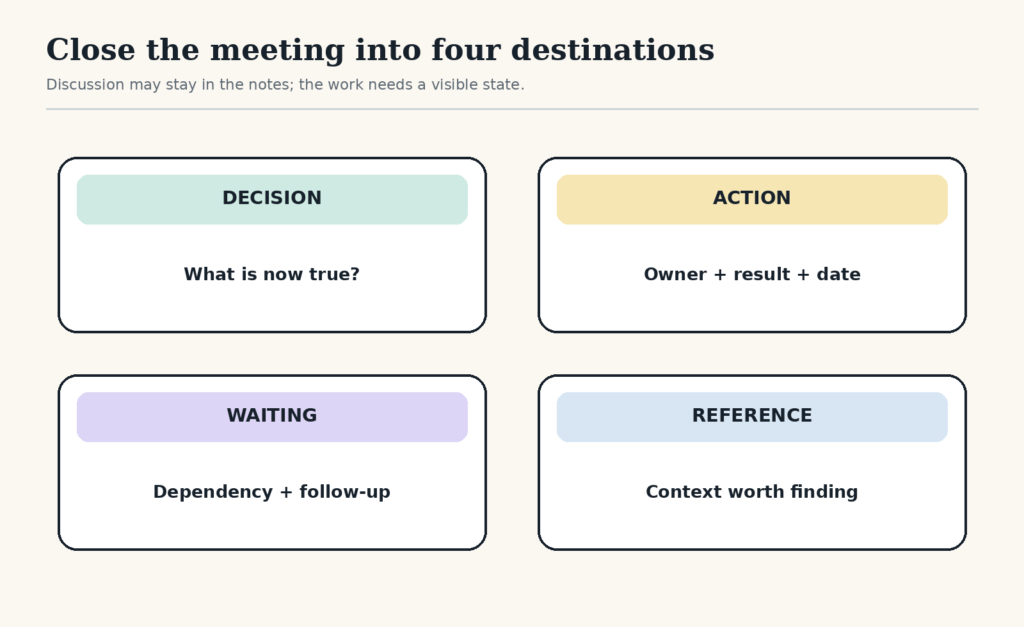
A useful meeting-notes system separates four kinds of information before the meeting ends: decisions, actions, waiting items, and reference.
Open the page with four destinations
| Destination | What belongs there | Required detail |
|---|---|---|
| Decision | A choice the group made | What was chosen and its scope |
| Action | Work someone can begin | Owner, visible result, and due or review point |
| Waiting | Work blocked by another person or event | Dependency and follow-up trigger |
| Reference | Context worth retaining | Short summary or stable link |
Discussion notes can sit below these sections, but they should not be expected to perform all four jobs.
Write decisions as boundaries
“Discussed launch date” is a topic, not a decision. Write what is now true:
- “Pilot launches to the existing email list on 8 September.”
- “The mobile redesign is outside this release.”
- “Use the supplier’s standard packaging for the first 100 units.”
If the group did not decide, record that honestly: “No date chosen; Maya will confirm supplier lead time before the 20 August review.” That line contains a waiting condition and the next decision point.
Turn actions into visible results
A meeting action needs an owner and an observable change. “Alex — website” is not enough. “Alex — replace the pricing table on staging and send the preview link by Thursday 2 p.m.” can be confirmed without reopening the entire conversation.
Use this sentence pattern:
Owner will produce or change something visible by a date, event, or review point.
When work is still too broad, use the visible-next-action method before assigning it.
Move blocked work to Waiting
Actions that depend on approval, delivery, access, data, or another person should not remain mixed with available work. Record the item, dependency, follow-up date, and re-entry action.
For example: “Product photos — waiting for photographer’s final files — follow up Friday — then resize five homepage images.” The item can now move to the Waiting List instead of returning to every daily plan.
Use reference notes sparingly
Keep context that changes a later decision, protects a constraint, or explains why the group chose a route. Avoid transcribing every sentence unless the meeting has a formal record requirement.
Useful reference lines include:
- the customer requirement that shaped the decision;
- a link to the current specification or source file;
- a risk the owner must check;
- a rejected option that would otherwise be raised again without new evidence.
For regulated, legal, governance, employment, or clinical meetings, follow the required recordkeeping and approval rules. This lightweight system is for ordinary project and household coordination, not a substitute for formal minutes.
Close the meeting with a two-minute readback
- Read each decision aloud or on screen.
- Confirm every action owner accepts the wording.
- Check dates against real dependencies.
- Name who will follow up on waiting items.
- State where the notes will live.
The readback is where ambiguous notes become operating agreements. It is cheaper to repair “I thought you owned that” while everyone is present.
Example: turn a 30-minute launch call into five records
A small team meets about a workshop. The raw discussion covers ticket price, venue capacity, design, speaker confirmation, and refund terms.
The final notes contain:
- Decision: 40-seat pilot at $29; no early-bird tier.
- Action: Imani will publish the draft registration page on staging by Wednesday.
- Action: Rob will send the refund-policy draft to the owner by Tuesday.
- Waiting: speaker bio; follow up Thursday; then add to page.
- Reference: venue contract limits attendance to 40.
The full conversation does not need to become five pages. The work now has state, ownership, and a return point.
Store notes where the next action can find them
Use a stable pattern such as project-meeting-notes-2026-08-15, then place the file in the project’s shared home. The simple file-naming system helps when “notes-new-final” has become common.
Copy actions into the system where owners already work. Do not require everyone to remember that the only authoritative task list is hidden in meeting prose.
Audit the notes one day later
Open the page without replaying the meeting. Can you identify what changed, what can be done now, what is blocked, and where the supporting information lives? If one answer is missing, repair that destination—not the entire template.
Meeting notes are complete when they reduce the number of conversations required to understand the work.
Free GentleDone resource
Overwhelmed? Start with 10 minutes.
The GentleDone 10-Minute Reset gives you one deliberately small place to begin.