
A room can be usable long before it is spotless. The sink can be available, the floor path clear, the towels dry, and the things needed next returned to reach—even if the grout, cabinet fronts, and storage shelves still need attention.
The GentleDone cleaning system starts with that usable state. It separates quick restoration from deeper cleaning so a ten-minute reset does not quietly turn into an afternoon project.
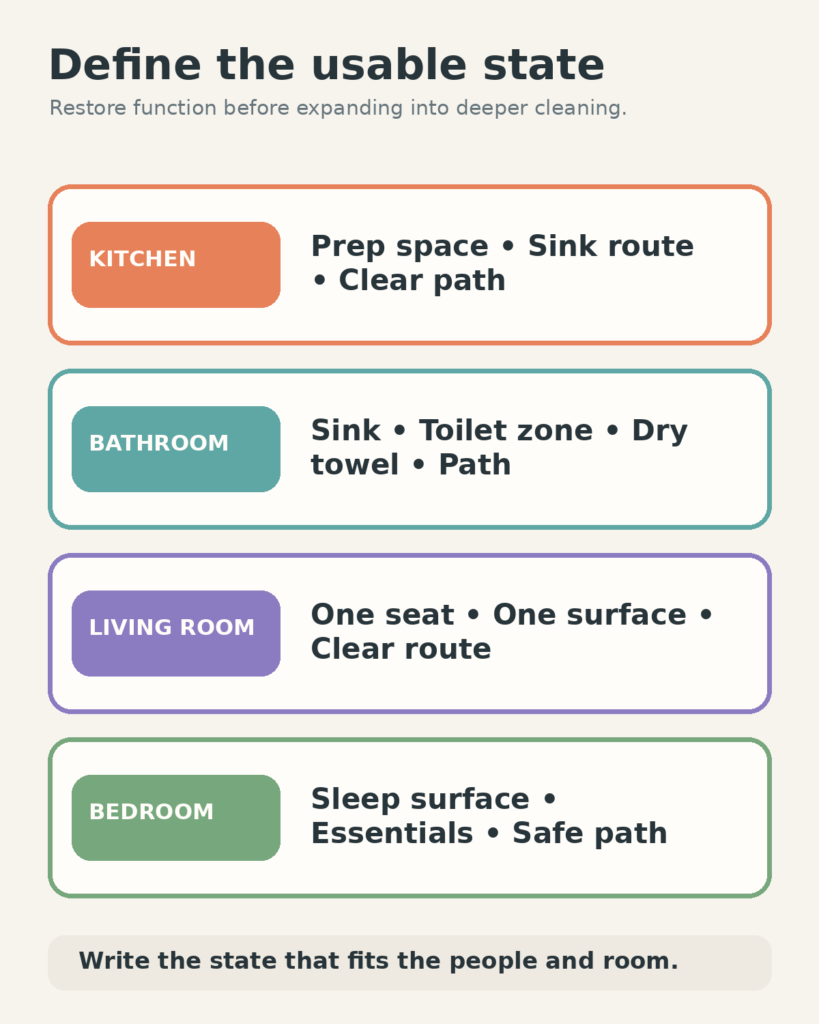
Define what “usable” means in each room
“Clean the kitchen” is difficult to finish because the finish line can keep moving. A usable-state definition gives the room a stable exit.
- Kitchen: one food-prep surface, one working sink route, obvious food put away, and a clear walking path.
- Bathroom: accessible sink and toilet zones, a dry towel available, supplies returned, and the floor path clear.
- Living room: one usable seat, one usable surface, and a route through the room.
- Bedroom: a usable sleep surface, tomorrow’s essentials reachable, and a safe path from door to bed.
These are examples, not universal standards. A shared home, mobility need, child, pet, allergy, or health situation may change the correct definition. Write the state that makes the room function for the people using it.
Build every room around four parts
- Usable state: the small set of conditions that lets the room do its main job.
- Reset route: the same short order used to restore those conditions.
- Supply home: the few tools needed for the route, stored close enough to use.
- Deep-clean list: separate work that can wait for a suitable time, product, or level of effort.
The separation matters. If every reset includes descaling, sorting drawers, washing walls, or reorganizing storage, the reset stops being a dependable route.
Cleaning and disinfecting are different jobs
For an ordinary household reset, cleaning and disinfection are not automatically the same task. CDC guidance on cleaning and disinfecting says cleaning with soap and water can remove most germs in many situations, while disinfection becomes more relevant when someone is sick or at higher risk.
That distinction keeps the routine honest. A quick surface reset can restore function without claiming to disinfect the room. When disinfection is needed, follow the product label, required surface-contact time, ventilation guidance, and any health-specific instructions for the household.
Never mix bleach or disinfectants with other cleaners. The CDC warns that combinations can release vapors that are dangerous to breathe. Use one appropriate product at a time and follow its label.
Choose one fixed route instead of scanning the whole room
Scanning creates a new decision for every object. A route lets you begin in the same place and stop at the same boundary.
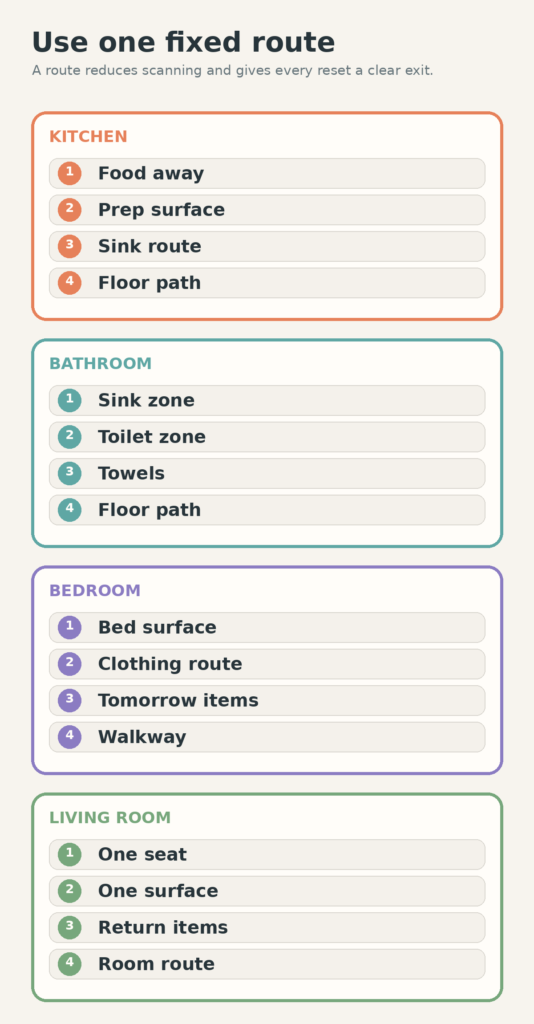
A kitchen route might be: put away food, clear one prep surface, restore the sink route, wipe the chosen surface, clear the floor path. The Dish Reset handles the sink when dishes are the main blockage.
A bathroom route can move through the sink zone, toilet zone, towels and supplies, then the floor path. Use the bounded version in The Bathroom Reset That Takes Less Than Ten Minutes.
A bedroom route might restore the bed surface, gather clothing into its current destination, place tomorrow’s essentials, and clear the walking path. Laundry processing remains a separate system; if folding is the recurring blockage, use the Laundry System That Works Without Folding Everything.
Keep supplies close, but keep the kit small
A portable caddy can help when several rooms use the same safe products. A room-specific cloth or simple tool home can be better when carrying supplies is the reason the route never begins.
Store only what the reset actually uses. A crowded caddy creates searching, expired products, leaking containers, and uncertainty about which product belongs on which surface. Keep original labels attached and store products according to their instructions, away from children and pets.
A minimal route may need only an appropriate surface cleaner, cloths assigned to suitable uses, a small waste-bag supply, and the room’s normal brush or floor tool. This is not a shopping list; use products and tools already known to be safe for the surfaces in your home.
Use a separate list for work that should not enter the reset
Deep cleaning is real work. It simply needs its own decision.
- descaling taps or shower screens;
- washing grout or walls;
- cleaning behind appliances or furniture;
- sorting cabinets and expired supplies;
- repairing leaks, damaged sealant, or ventilation problems;
- addressing mold, pests, sewage, sharps, or other hazards that may require specialist guidance.
Write these items down without beginning them during the reset. Schedule only the one that is currently worth the effort or necessary for safety.
Match the version to the room’s current condition
Minimum restores one essential use: one prep space, one clear sink, one usable toilet zone, one seat, or one sleep surface.
Normal completes the short fixed route for the room.
Restart leaves the next action visible: put the cloth beside the appropriate product, place the empty basket at the pickup point, or clear the first square of surface. Restart is not a failed Normal version. It is a deliberate way to lower the cost of returning.
A realistic weekly rhythm is a menu, not a debt schedule
You can assign likely days to rooms, but do not make every missed reset accumulate. On a disrupted week, choose the room whose usable state protects the next day most. The bounded Weekly Reset can hold this decision without becoming a complete-house checklist.
If the home has been difficult to maintain for a while, begin with function: a safe path, a usable hygiene area, food-prep space, clean essentials, and waste that needs removal. Do not treat cosmetic work as more urgent than access or safety.
Restart with one room and one exit
After a long gap, choose the room that is blocking everyday use. Write its usable state in one sentence. Follow its route once, stop at the stated exit, and leave the deep-clean list untouched.
The system is working when the room becomes easier to use and easier to reset—not when every surface proves how hard you worked.