
A sink full of dishes is rarely one task. It is yesterday’s plates, a pan that needs soaking, cups still being used, a drying rack with nowhere to put the next load, and the question of where to begin.
The useful unit is not “finish every dish.” It is one complete load that moves from dirty to dry without creating a new jam.
Stop using the sink as the waiting room
When every dirty item goes into the sink, you lose the sink itself. Filling a pot, rinsing produce, and washing one needed mug all require moving a wet, unstable stack first.
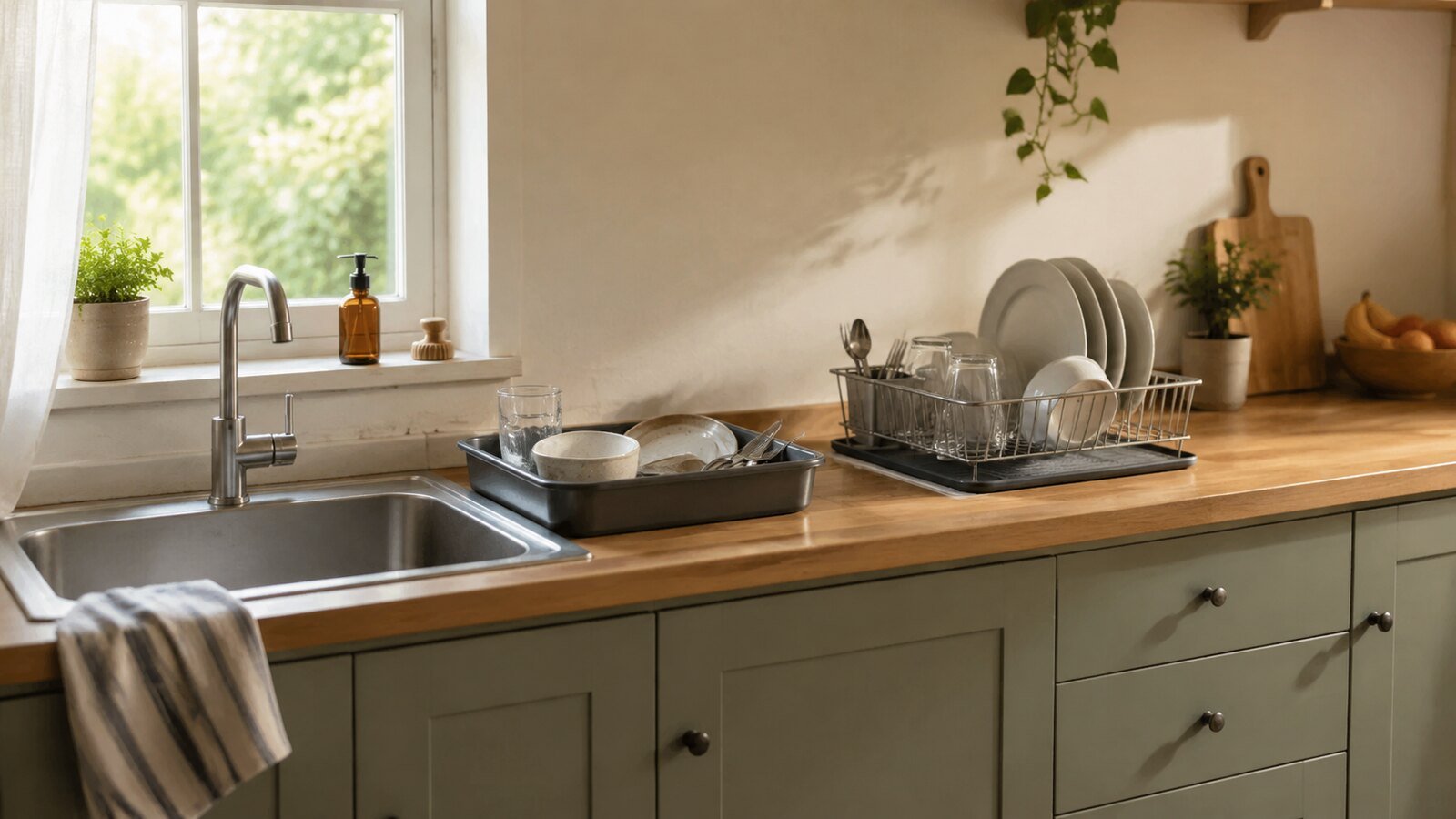
Choose a bounded waiting zone beside the sink: a dish tub, a washable tray, or one section of counter. Scrape food into the appropriate waste container, then place dishes there. Keep the sink available for water and washing.
The boundary matters. When the tray is full, it is time to run one load. Do not begin a second dirty stack elsewhere.
Give dishes three clear zones
The kitchen needs a short direction of travel:
- Waiting: scraped dishes that have not been washed.
- Washing: the dishwasher or the open sink.
- Drying: a rack, mat, or the dishwasher after its cycle.
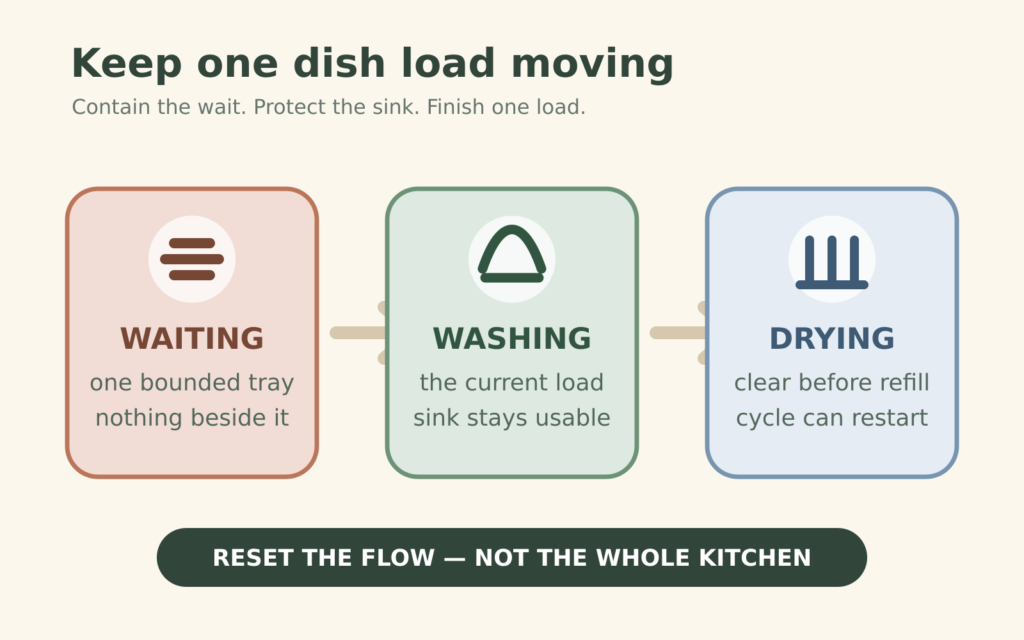
Keep the path moving in one direction. A clean item should never have to cross the dirty waiting zone to reach storage. In a very small kitchen, the same patch of counter can change roles, but only after the previous role is cleared.
Clear the exit before starting the load
A full drying rack can stop the system before washing begins. Spend two minutes putting away dry dishes first. If cabinets are crowded, remove one duplicate or move rarely used serving pieces elsewhere; daily dishes need the easiest shelves.
Then choose the load that restores the most function. Wash drinking cups if none are available. Clear the large pan if it blocks the sink. Load plates and bowls if they make up most of the stack. “Most useful next” is a better rule than “oldest item first.”
If you use a dishwasher, reduce unnecessary handling
Load items according to the machine and detergent instructions. ENERGY STAR advises users of suitable modern dishwashers to scrape food rather than pre-rinse, because pre-rinsing adds water and energy use, and to run properly loaded full cycles. Review the ENERGY STAR dishwasher guidance and follow your manufacturer’s directions when they differ.
Keep one small “not dishwasher-safe” area rather than leaving uncertain items scattered around the sink. Check them together. If an item needs special handling every time and is not important to you, consider whether it deserves daily-kitchen space.
If you wash by hand, batch by shape
Wash similar items together so the motions and storage destination stay consistent. A workable order is cups, cutlery, plates and bowls, then cookware. Adjust it when a greasy or allergen-contact item needs separate handling.
Use one basin or sink section for washing and preserve a clear draining area. When the rack is full, stop. Dry and put away that load before creating another tower.
Use a rescue load on difficult nights
A rescue load restores tomorrow’s basic function. It may contain:
- one cup, plate, bowl, and set of cutlery per person;
- the pan or tool needed for the next meal;
- food containers that must be cleaned promptly;
- the sink itself, once those items are out.
Leave the remaining scraped dishes inside the bounded waiting zone. Do not spread them across the room to make the sink look empty. The rescue is complete when the essential items are moving toward dry and the sink can be used again.
If low-capacity evenings also make food decisions difficult, pair the rescue load with a backup meal system that uses very few dishes.
Close with one visible signal
Choose a simple condition that means the kitchen is ready enough:
The sink is usable, the next load is contained, and one clean set is available.
This condition can be met without emptying every surface. It also makes the next session obvious: put away the drying load, then move the waiting load forward.
Repair the jam instead of increasing effort
| Where dishes stop | Change the handoff |
|---|---|
| Dry dishes stay in the rack | Put them away before washing and move daily items to easier storage. |
| The sink disappears under dishes | Use one bounded waiting tray beside it. |
| One pan blocks everything | Make that pan the first functional load. |
| Uncertain items remain forever | Create one small hand-wash zone and decide on those items together. |
| A rescue becomes a full clean | Stop once the sink is usable and tomorrow’s basic set is moving toward dry. |
Set up the system with the next load
- Put away anything already dry.
- Choose one waiting tray or dish tub.
- Clear the sink and drying exit.
- Select the load that restores the most useful kitchen function.
- Move that load all the way to drying before adding another.
A kitchen does not stay usable because dishes never accumulate. It stays usable because the accumulation has a boundary and the next load has somewhere to go.
Free GentleDone resource
Overwhelmed? Start with 10 minutes.
The GentleDone 10-Minute Reset gives you one deliberately small place to begin.