
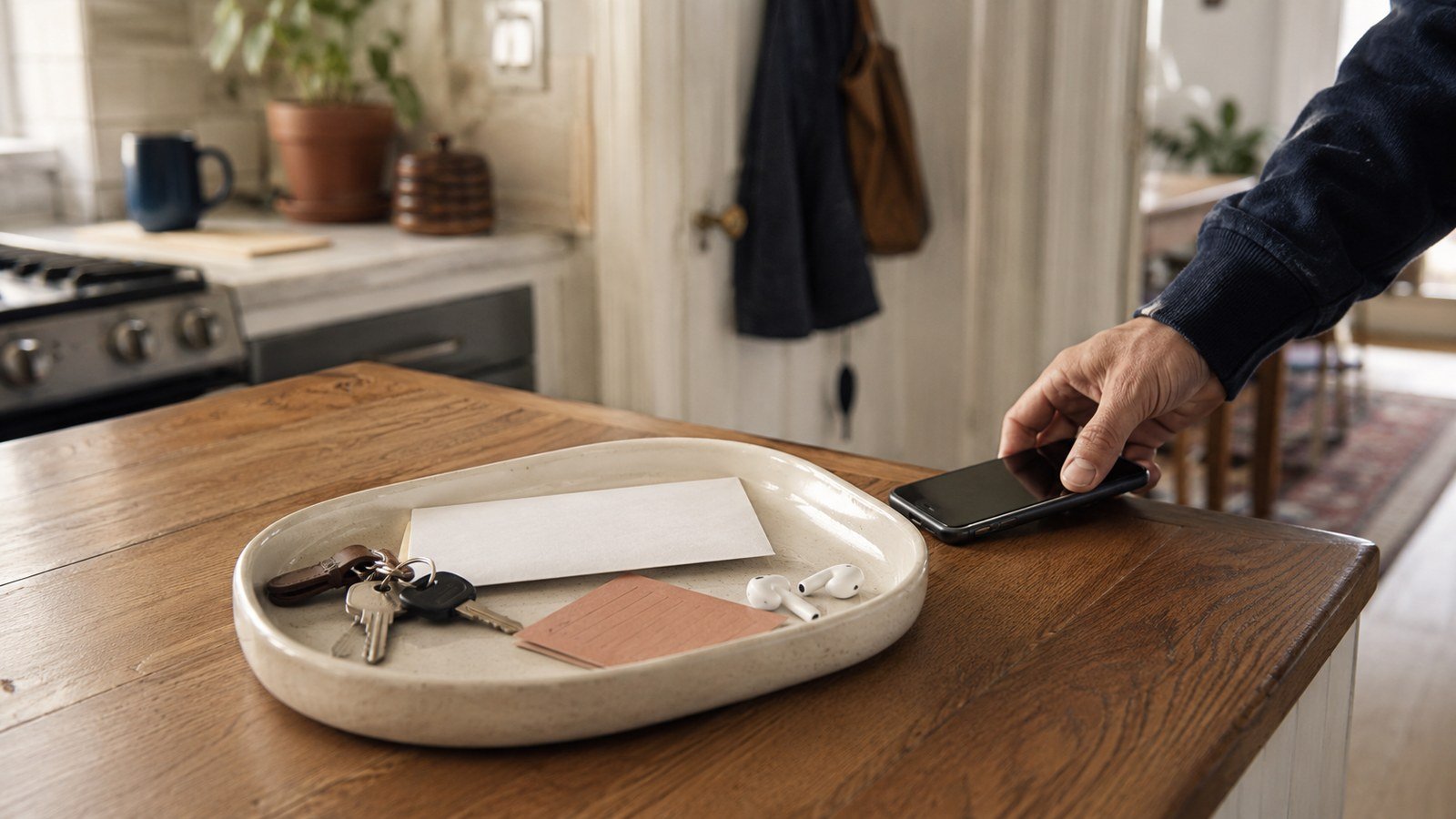
Everyday clutter needs somewhere to land before it can be processed. If every surface is forbidden, the rule usually collapses the first time someone comes through the door with a bag, a receipt, a parcel, and a phone in one hand.
The One-Surface Rule gives those arriving objects one legal landing zone. The zone is small, visible, and allowed to look unfinished for a short time. Other surfaces keep their useful function, and the landing zone has a closing route that does not require a full-room reset.
Choose a surface that is already receiving things
Do not create a landing zone on the far side of the room because it looks tidy there. Choose the place where objects already pause: the end of a kitchen counter, one shelf near the door, a tray on the entry table, or one section of a desk.
The best location is:
- close to the main arrival or transition point;
- stable enough for the objects that actually land there;
- away from food preparation, open flames, water, and walkways;
- visible enough that unfinished items do not disappear;
- small enough that its capacity is obvious.
If the natural drop point is unsafe or blocks a needed function, move the landing zone to the nearest safe surface—not the nearest ideal room.
Set a physical boundary, not a vague intention
“Keep clutter to one area” is hard to recognize. A tray, shallow basket, placemat, or taped rectangle creates a visible edge. Choose a boundary that can hold a normal day’s arrivals without becoming permanent storage.
The boundary is also the capacity rule: items may wait inside it, but they may not spread beyond it or build a second layer that hides what is underneath. When the boundary is full, close the route before adding more.
A tall container can hide volume until it becomes a difficult sorting project. For mixed everyday items, shallow usually works better because the contents remain visible and the limit arrives sooner.
Give the landing zone four exits
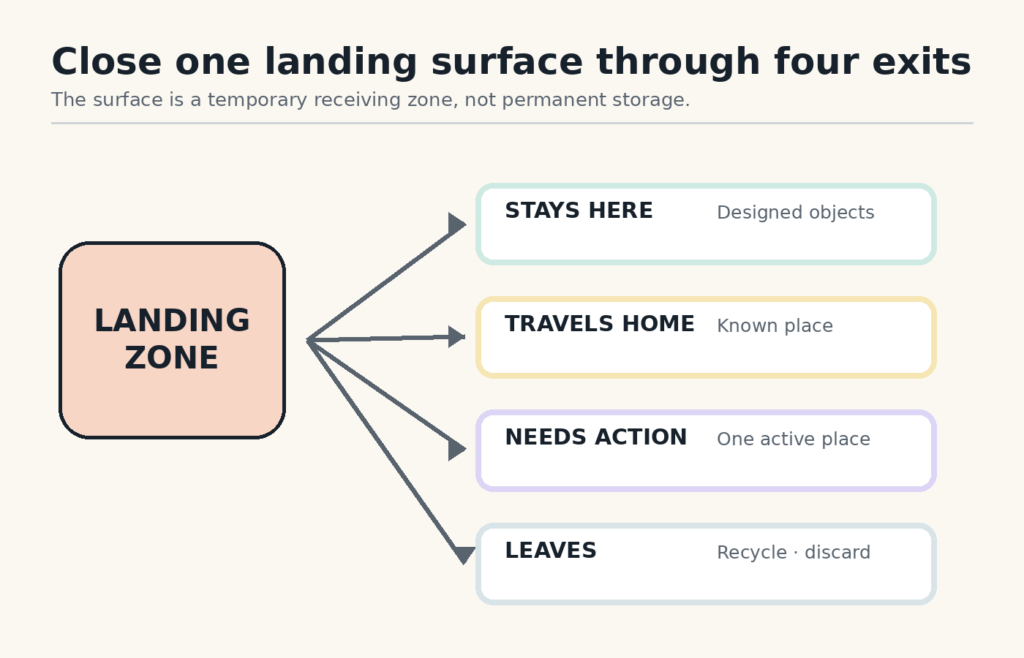
Closing the surface should be a route, not a debate. Every object has one of four exits:
- Stays here: the small number of objects the surface is designed to hold, such as keys in their tray.
- Travels home: objects with a known place elsewhere. Put them in one carry basket if they need to visit several rooms.
- Needs action: a bill, form, return, or repair. Move it to one active-action place and record the next step if needed.
- Leaves: recycling, rubbish, packaging, expired paper, or an item already designated for donation.
“Needs action” is not permission to create another unbounded pile. Give action items one folder, clip, tray, or digital reminder. If that place is full, choose what will be completed, scheduled, or released before adding more.
Protect the other surfaces by function
The One-Surface Rule works because it is not a request for every horizontal plane to remain empty. It creates a contrast: this zone may receive unfinished arrivals; the others preserve their jobs.
- The kitchen preparation area stays available for preparing food.
- The dining table keeps enough clear space for the next meal.
- The sofa stays available for sitting.
- The bedside table holds only what supports sleep and the night.
- The desk preserves the area needed for the current work.
Use a specific sentence: “Parcels and papers may land in this tray; the preparation counter stays clear.” A functional boundary is easier to remember than a general instruction to be tidy.
Close the route at a real transition
Do not attach the closing route to a perfect clock time unless your days reliably support it. Attach it to something that already happens: before starting dinner, after putting away groceries, when plugging in the phone, or during the end-of-day reset.
A normal close takes five to ten minutes. Begin with the obvious exits—rubbish and known homes—then handle action items. Stop when the boundary is usable again. The rest of the room does not need to be finished.
On a low-capacity day, use the minimum close: remove food, liquids, safety risks, and anything needed tomorrow. Contain the rest inside the boundary. The surface remains honest about unfinished work without allowing the unfinished work to spread.
Use one surface per arrival route, not per room
A small home may need only one landing zone. A larger or multi-level home may have two genuinely different arrival routes—for example, a front-door zone for personal items and a kitchen zone for groceries and household papers.
Do not automatically create one in every room. Each landing surface produces a closing obligation. Add a second only when objects repeatedly enter through another route and transporting them immediately is the exact friction causing the pile.
Make the rule workable in a shared home
Agree on what may land, what must never land, and when the boundary is considered full. Keep the rule observable. “Nothing beyond the tray edge” is clearer than “please do not leave too much here.”
Give each person a simple onward route. A labeled return basket, inbox, or hook can be more useful than expecting one person to identify and put away everyone else’s objects. If an item belongs to no one or has no known home, place it in a short-term decision box and set a date to empty that box.
Repair the rule when it keeps overflowing
Overflow usually points to one of four problems:
- The close never starts: attach it to a stronger transition or reduce it to a two-minute minimum.
- Objects have no home: create one near the point of use using the low-friction organization method.
- Action papers stall: define one next-action location and review it separately from the surface reset.
- The boundary is too large: make it shallower or narrower so the capacity becomes visible earlier.
Do not add more landing zones to solve an unclosed one. First shorten its exits. A successful surface does not stay empty all day; it receives ordinary life without allowing every other surface to become storage.
Free GentleDone resource
Overwhelmed? Start with 10 minutes.
The GentleDone 10-Minute Reset gives you one deliberately small place to begin.