
A routine can work for two quiet weeks and still collapse the first time work runs late, a child stays home, or you miss three days. That does not automatically mean the routine was a bad idea. It may mean the routine depended on one exact version of the day.
A more durable routine has four parts: a cue you can still notice when timing moves, a smaller version for limited days, a rule for changing one part at a time, and a restart point that does not require catching up. Together, those parts keep the route reachable without pretending every day has the same capacity.
A flexible routine protects the route, not the streak
Repetition in a consistent context is one way actions can become easier to start. A review of habit research describes routines such as “after breakfast” or “during a lunch break” as stable contexts that can cue a chosen action. Context matters, but the same review also notes that habit development varies by behavior and person; it is not a fixed-day promise. See the review of habit formation and health behavior.
That makes the design problem clearer. If the only cue is “7:00 a.m. on a normal weekday,” the action loses its entrance when the clock, place, or sequence changes. A flexible routine keeps one recognizable entrance and allows the size or timing window to move around it.
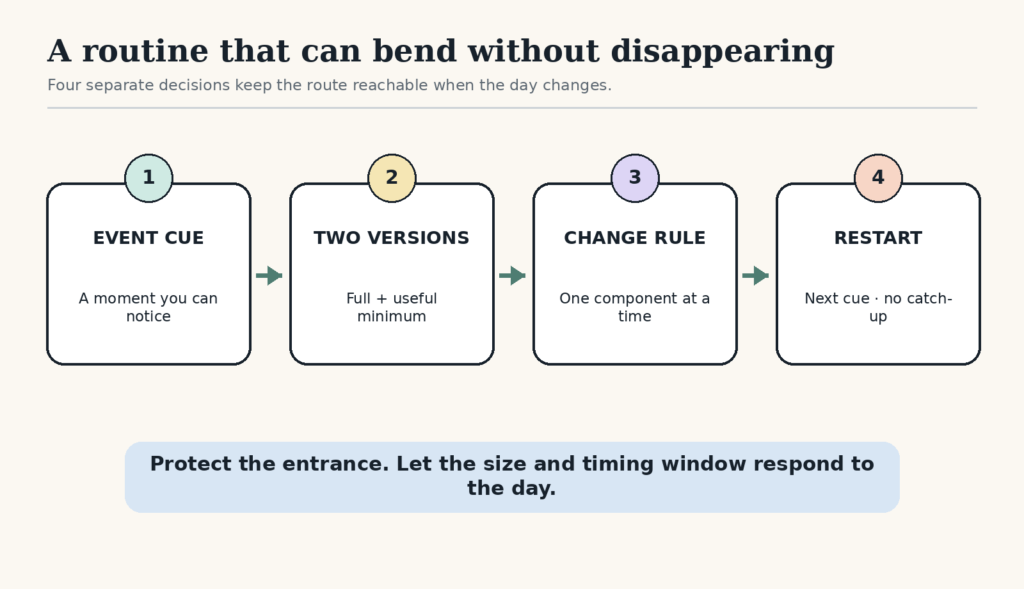
Build the routine from four separate decisions
1. Choose a cue that survives ordinary schedule changes
A clock time can be useful for appointments, but it is often a fragile trigger for everyday routines. Look for an event that already happens near the action: the kettle switches off, lunch dishes reach the sink, the work laptop closes, or your bag lands by the door.
Write the connection plainly: “After I close the laptop, I will write tomorrow’s first task.” This resembles an implementation intention—an if-then plan that connects a recognizable situation with a response. The National Cancer Institute’s overview of implementation intentions explains the planning construct and its evidence base; it does not guarantee that any particular routine will become automatic.
If you need help selecting and testing an anchor, use the event-based routine guide.
2. Give the routine a full version and a minimum version
The full version should produce the result you want on an ordinary day. The minimum version should keep the route open on a difficult day. It begins at the same cue, contains one real action, and has its own stop line.
For an end-of-work routine, the full version might capture open tasks, choose tomorrow’s first task, clear the desk, and plug in the laptop. The minimum might be one line in a notebook: “Start with the revised invoice.” That smaller version does not finish everything. It protects tomorrow’s entrance.
The Minimum-Version Rule shows how to make the smaller version useful rather than symbolic.
3. Decide what may change without rebuilding the whole routine
Routine components fail for different reasons. The cue may be invisible. The action may be too large. The tools may live in the wrong place. The sequence may have one irritating handoff. Change the failing component while keeping a familiar part stable.
For example, if “after dinner” is still easy to notice but a 20-minute kitchen reset is not happening, keep the cue and shrink the action for one week. If the action is fine but dinner happens in different places, move the cue to “when the last plate reaches the sink.”
Use the one-change routine trial when you need to adjust a routine without erasing its entrance.
4. Name a restart point before you miss a day
A restart point is the next ordinary cue, not a special recovery project. If you miss the evening reset on Tuesday, restart when the laptop closes on Wednesday. Do not add Tuesday’s full routine to Wednesday’s workload.
In one study of 96 volunteers repeating a chosen eating, drinking, or activity behavior in the same context, missing one opportunity did not materially change the modeled habit-formation process. The time course varied widely, and the result concerns that specific study—not every routine or a long disruption. The useful, limited reassurance is that one miss need not be treated as total failure. Read the original habit-formation study.
Match the repair to the way the routine breaks
| What you notice | Likely weak point | First repair to try |
|---|---|---|
| You remember only after the useful moment has passed | Cue | Move the cue to a visible event immediately before the action |
| You notice the cue but avoid starting | Action size | Create a minimum version with a clear stop |
| You start, then leave to find supplies | Environment | Park the first tool at the point of action |
| The routine works at home but disappears elsewhere | Context | Keep the outcome and build a second location-specific cue |
| One missed day becomes a missed week | Restart rule | Return at the next cue with the minimum version |
Do not apply every repair at once. If the next attempt works, you need to know which change helped. If it does not, one preserved component gives you a stable place for the next trial.
See how the system handles a changing workweek
Suppose Maya wants a short movement routine after work. On office days she arrives home at 6:20. On home days she stops at 5:00. A 5:30 alarm fits neither day reliably.
She uses “after I put away the work laptop” as the cue. The full version is a 15-minute walk followed by a glass of water. The minimum is putting on shoes and walking to the end of the block, with permission to turn back. Her change rule is simple: keep the laptop cue for seven attempts and change only the route or duration. If she misses the cue, she restarts the next time the laptop is put away; there is no makeup walk.
When travel removes the usual laptop-and-home context, she does not pretend the cue still exists. She creates a temporary travel version: “after I set my room key down, I will walk one corridor or step outside for two minutes.” The desired action remains recognizable, but the local entrance changes.
Context changes deserve a planned bridge
Research on people moving between familiar and unfamiliar contexts suggests that context changes can disrupt the cues supporting established behavior. A study of university transfers found that changes in performance context were associated with changes in habit expression; the population and transition were specific, so the finding should not be treated as a universal rule. It does support a practical question before travel, a move, a new job, or a seasonal schedule change: Which cue is about to disappear? See the original context-change study.
Build a bridge before the old context ends:
- Name the result the routine protects.
- Identify the old cue that may disappear.
- Choose a new event likely to happen in the new setting.
- Use the minimum version for the first few attempts.
- Expand only after the entrance is easy to find.
Some routines need a stronger safeguard than flexibility
Do not use a casual restart rule for medication, medical care, child safety, food safety, financial deadlines, or any task where a missed action could cause serious harm. Use alarms, written procedures, another person, professional instructions, or a formal backup appropriate to the consequence.
For ordinary household and personal routines, the free Routine Restart Worksheet can help you decide what to keep, shrink, move, or remove. Start with the routine that has the clearest next consequence. Repair one weak point, then watch the next few real attempts before changing anything else.