

A routine with only a full version quietly asks the same question every day: “Can you do all of this now?” On a low-capacity day, the honest answer may be no. Without another valid finish line, no becomes the only route.
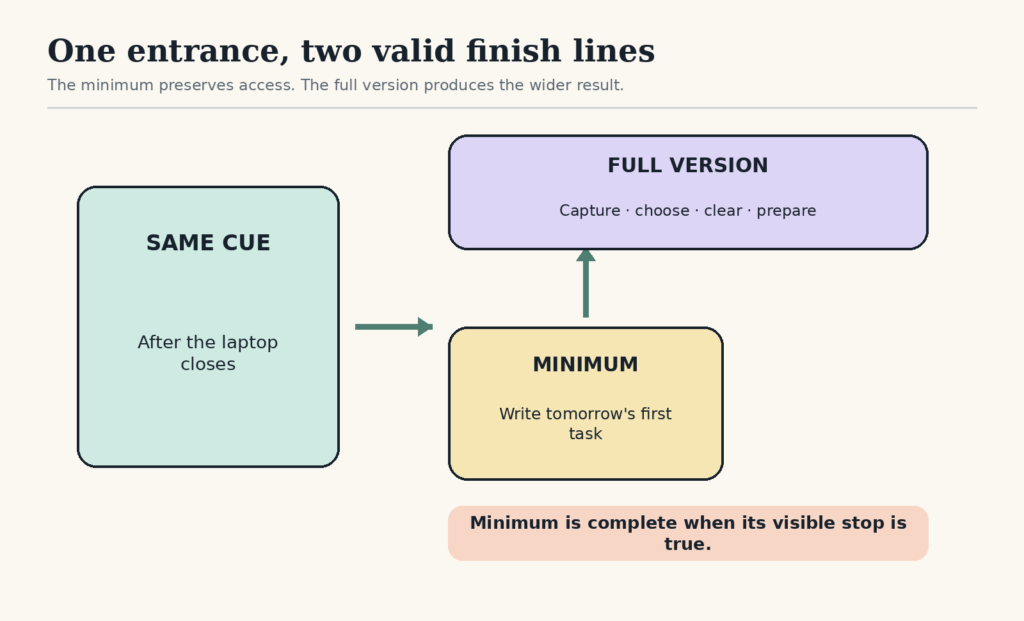
The Minimum-Version Rule gives the routine a smaller, useful action that begins at the same cue. It does not claim to produce the full result. Its job is to keep the entrance reachable and protect the next consequence that matters.
A minimum version must do something real
“Think about the routine” is usually too symbolic. “Open the document and write the next missing heading” changes the state of the work. “Look at the kitchen” does not restore a function. “Put refrigerated food away and clear one preparation square” does.
A useful minimum passes three tests:
- It begins from the routine’s usual cue.
- It reduces a real consequence or prepares an obvious next action.
- It has a stop line you can honor without guilt.
Build the smaller version from the protected result
Do not shrink the routine by randomly removing steps. First name what the full routine protects. Then choose the smallest action that still serves that purpose.
- Name the result. “Tomorrow’s work has a visible first action.”
- Find the nearest consequence. Without the routine, you may reopen the laptop and spend ten minutes reconstructing where to begin.
- Choose one physical action. Write the first task on a note and place it on the keyboard.
- Keep the cue. Start after the work laptop closes or before it closes for the final time.
- Write the stop. Once the note is placed, the minimum version is complete.
The smaller route is now complete enough to use and honest enough to trust.
Minimum and full versions should share an entrance
If the minimum version happens at a different time, in a different place, with different tools, it may become a second routine to remember. Keep the opening cue and first motion as similar as practical.
For example, both versions of an evening kitchen routine begin when the last plate reaches the sink. The minimum puts away food that needs refrigeration and clears one preparation square. The full version continues through dishes, a wipe, and tomorrow’s first meal setup.
When the cue itself is unreliable, repair it with an event-based anchor before refining the versions.
Use the smaller route to protect access, safety, or tomorrow
| Routine | Full result | Useful minimum |
|---|---|---|
| End of work | Capture open loops, plan tomorrow, clear desk | Write tomorrow’s first task and place it where work begins |
| Kitchen close | Dishes moved, surfaces usable, breakfast prepared | Put perishable food away and clear one preparation area |
| Laundry return | Clean load reaches its storage homes | Move the clean load into one usable, labeled container |
| Morning preparation | Dress, eat, pack, and leave with needed items | Put the essential carry item and shoes at the exit |
Safety-critical tasks require a complete safeguard, not a casual minimum. Medication, medical care, child safety, food safety, and legal or financial deadlines may need professional instructions, alarms, checklists, or another person. Do not reduce a required safety step because it is inconvenient.
Decide the minimum before the difficult day
Low-capacity moments are poor times to negotiate what counts. Write the two versions while the routine is calm:
Full: after I close the work laptop, I capture open tasks, choose tomorrow’s first task, clear the desk, and plug in the laptop.
Minimum: after I close the work laptop, I write tomorrow’s first task and place the note on the keyboard. Then I may stop.
Keep the wording close to the point of action. A card inside the cabinet, a line at the top of a checklist, or the first two boxes in an existing note is enough. A separate app can add more maintenance than the rule removes.
Do not turn the minimum into a hidden requirement to continue
The minimum fails if it says “you may stop” but is always followed by shame, bargaining, or an automatic expansion. On some days momentum will carry you into the full version. That is optional.
If stopping after the minimum repeatedly causes a serious consequence, the version is too small or the routine is carrying work that belongs elsewhere. Change the protected action, reduce the frequency, move the cue, or create a separate scheduled task. Do not call an inadequate action “minimum” and hope the name fixes the design.
Return to the full version through evidence, not repayment
After a difficult stretch, use the minimum at the next cue. If starting feels straightforward for two or three relevant opportunities and capacity has returned, choose the full version on one ordinary day. There is no need to complete the full routine once for every day you used the minimum.
A study of 96 volunteers repeating a selected eating, drinking, or activity behavior in the same context found wide variation in modeled habit formation. Within that study, missing one opportunity did not materially affect the process. The result does not tell us that long gaps never matter or that every routine behaves the same way. It does support avoiding catastrophic conclusions after a single miss. Read the original study and its limits.
When the minimum keeps becoming the default
Using the smaller route for a week is not automatically a problem. It may fit the season. Review it when one of these conditions appears:
- The protected result is no longer being protected.
- The same unfinished work accumulates after every minimum.
- You have capacity for the full version but the first step still feels wrong.
- The cue happens, but the routine belongs at a different point in the day.
At that point, use a one-change trial rather than expanding the minimum through pressure. If the whole routine has been absent, the Routine Restart Worksheet will help you decide what to keep, shrink, move, or remove.
A minimum version succeeds when it leaves the routine easier to find next time. Make it small enough to enter, useful enough to count, and complete enough to stop.
Free GentleDone resource
Overwhelmed? Start with 10 minutes.
The GentleDone 10-Minute Reset gives you one deliberately small place to begin.