
A routine can disappear for a week and leave you with four competing ideas: return to the old version, make it smaller, move it to another part of the day, or stop doing it. Trying all four at once creates a new routine before you understand why the old one slipped.
The free Routine Restart Worksheet gives you one page for that decision. It includes a cue audit, Keep/Shrink/Move/Remove choices, a minimum-version builder, and a seven-day re-entry record. Download the same worksheet in US Letter or A4.
See the complete one-page worksheet
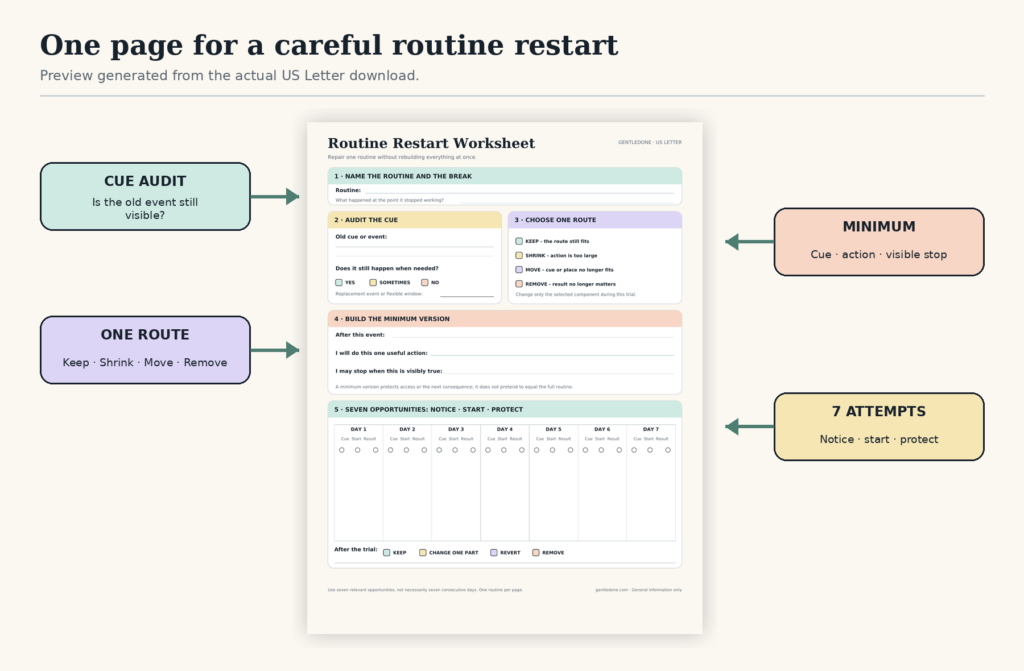
The preview is generated from the actual printable. The writing areas are intentionally brief. This is a working decision page, not a diary or a complete habit tracker.
Start with one routine and one visible break
Write the routine in concrete terms. “Take better care of evenings” is too broad. “After the last dinner plate reaches the sink, put food away and clear one preparation area” gives you a cue, an action, and a finish line to examine.
Then describe what happened at the point of failure:
- The cue stopped happening.
- The cue happened, but you noticed too late.
- You noticed and did not start.
- You started and met a tool, time, or sequence problem.
- You finished, but the cost was too high to repeat.
Choose the closest description. You do not need a perfect explanation before making one careful change.
Audit the cue before changing the action
The cue section asks what used to start the routine, whether that event still happens, and what event could replace it if necessary. Keep a visible cue when it still fits. Replace it when the context has genuinely changed.
For help choosing an event close to the action, use How to Build a Routine Around an Event Instead of a Clock.
Choose one route: Keep, Shrink, Move, or Remove
Keep when the routine still fits and the break was temporary. Restart at the next cue without catching up.
Shrink when the cue is visible but the action is too large for current capacity. Use the Minimum-Version Rule to preserve one useful result.
Move when the routine’s current cue, place, or sequence no longer matches the day. Keep one familiar component while testing the new position.
Remove when the routine no longer protects a result you need, duplicates another system, or costs more than it returns. Removal is a valid design decision. Cross it off deliberately so it stops creating background debt.
Write a minimum version with a real stop
Use one sentence:
After [event], I will [one useful physical action]. I may stop when [visible finish].
Example: “After I close the work laptop, I will write tomorrow’s first task on a note. I may stop when the note is on the keyboard.”
A stop line matters because a minimum version is not an invitation to trick yourself into the full routine. If you continue, that is a fresh choice.
Use the seven-day row as evidence, not a score
For each relevant day, mark three small signals: Did you notice the cue? Did you start? Did the useful result get protected? Add a few words only when something interrupted the route.
If the routine does not occur every day, use the seven boxes for seven opportunities rather than seven consecutive calendar days. A weekly routine may need seven weeks. The worksheet is measuring the route, not your worth or discipline.
Review only after the chosen trial
At the end of the row, choose one decision:
- Keep this version because the entrance and result work.
- Change one component because the same friction repeats.
- Return to the earlier version because the trial added friction.
- Remove or replace the routine because the result no longer matters.
If several components need changing, use the one-change routine trial to preserve a recognizable starting point. For the complete model behind the worksheet, read Routines That Survive Missed Days and Changing Schedules.
Download the Routine Restart Worksheet
Choose the page size that matches your printer. Print at 100% or Actual Size. Both files contain the same one-page worksheet.
Keep one clean master copy and work on only one routine per page. If the routine supports medication, medical care, child safety, food safety, or another high-consequence task, use the safeguards and professional instructions appropriate to that task rather than relying on this worksheet alone.